Attitudes to and experiences of the economy and cost of living vary across Reform UK’s large coalition. The party is unlikely to keep both financially precarious workers and retired homeowners happy as it develops a concrete policy platform. We propose some tactics to help progressives turn voters away from Reform using economic messages.
HOPE not hate commissioned 229 AI-moderated in-depth interviews to dig into Reform’s party/voter economic divide. Participants are real people conversing with an AI chatbot. When it comes to personal finances and the cost of living, privacy can be revealing.
Cost of living struggles
The cost of living is no less a priority for Reform voters as it is for the rest of the UK. Although the party’s base has diversified, there is still an overrepresentation of voters in lower income bands. Reform voters are more likely than Conservative and Labour voters to describe themselves as worried about their financial future (28%) or getting by, but making cutbacks (32%).
Interview participants emphasised acute pressures on daily costs, which contributes to a feeling that the economic system is unfair. Many express frustration that they work full time, pay their taxes but still struggle to make ends meet. Some, assuming there is no overlap between working taxpayers and people receiving welfare, feel that working people foot the bill of the welfare system with no benefit to themselves.
“I haven’t had any leave this year because I can’t afford to sit at home and rest – let alone pay to go on a holiday! it’s extremely stressful and demotivating”
– Male, 38, South East, 2024 Conservative
“I don’t see friends as much, due to the expense of travelling, fuel etc. … Why am I working when other people receive more money in benefits than I do for working”
– Female, 61, Yorkshire, 2024 Reform UK
A pared-down economy that supports working taxpayers
The majority of Reform voters want lower taxes, but for different reasons. Ex-Conservatives are ideologically aligned, whereas ex-Labour voters are supportive of any strategy that will help them keep more of their own money – it is non-ideological, self-preserving pragmatism.
“I think less support from the government financially encourages people to go out to work and support themselves”
– Female, 54, Yorkshire, 2024 Conservative
“I would love to say higher taxes, however as i already struggle on the wage i am on i would have to choose lower taxes”
– Female, 33, South East, 2024 Labour
Many Reform voters think government spending is wasteful and poorly managed. Some feel that public spending can be cut painlessly, whilst higher spending will not improve services. For others, distrust of the current Labour Government and a general lack of faith in the state to spend taxpayer money wisely means they favour lower spending even without a strong ideological commitment to this.
However, Reform has misjudged their supporters before in attempts to accuse the government of waste. Distaste after Richard Tice’s comments on SEND support, where he accused parents of “hijacking” and “abusing” the system, led to a follow up apology speech. In playing to their smaller conservative audience – with whom they are arguably more ideologically aligned – Reform’s leadership failed to recognise the more precariously supportive voters who support welfare in principle (for those who “really” need it) but are concerned about costs in practice.
Implicit trust in Reform and Farage
Although most voters cannot explain Reform’s economic policy in detail, the majority are clear that the party stands for lower taxation, reducing state waste and limited state intervention. A few participants also repeated Reform’s own talking point, that key figures in the party are entrepreneurial and financially successful. For others, a lack of trust in any other party or politician facilitates a roll of the dice on Reform.
“Reform UK, largely stuffed full of competent, business savvy people who talk sense, not political jargon … If you run a business, especially a large one, you understand that money doesn’t grow on trees”
– Male, 73, South West, 2024 Reform UK
“I’d give them a go, I don’t think they could make it any worse! I don’t really know much about their fiscal policies”
– Female, 59, East Midlands, 2024 Reform UK
Reform UK successfully reinforces some of the attitudes its supporters have about the economy: they feed a false dichotomy between people receiving welfare and people who work, and accuse the Labour Government of favouring the former; they draw attention to “wasteful” spending on relatively small-budget areas such as EDI, Net Zero and civil service pensions whilst steering clear of detail on big ticket items like the NHS and education; their policy announcements on the economy emphasise (implicitly white) British workers over migrant workers.
Immigration as an economic driver
It is unsurprising that many voters mention immigration as a part of Reform’s economic policy. To them, immigration is a central driver of economic decline: welfare, housing and jobs are limited resources that they are competing for against immigrants of all routes. They view the economy as a zero-sum game in which immigrants contribute minimally but extract maximally. Their support for Reform’s economic agenda is partially a spillover of their support for the anti-immigration stance.
“We are letting too many immigrants and its starting to kill our economy… The amount of immigrants and what we give them, it is costing the average working person”
– Male, 49, East Midlands, 2024 Reform UK
Of course, the extremely high costs of Reform’s proposed deportation policy – both the costs of the deportations themselves and the knock-on effects on the exchequer, workforce and public services – are not recognised by Reform voters. For many, controls on immigration are primary to economic stability.
“They should get a grip on immigration and the illegal boat crossings. The current labour government are just continuing and pretending it isn’t as issue. Reducing the unnecessary and unaffordable spending in this area will provide more money for services which people need such as health and reduce the requirements to increase taxes.”
– Male, 30, South West, 2024 Conservative
As well as asking voters about their attitudes, we presented them with a number of stimuli relating to Reform UK which reveal some different faultlines for both advocacy and campaigning work across political parties and third sector organisations.
Interview participants were shown an image of a leaflet from the May 2025 local elections which prominently said “FREEZE COUNCIL TAX” as a highlighted policy. They were then asked to watch a clip of Nigel Farage from a 28th November press conference in which he says “I did not make a single promise in that election that we would be able to freeze or cut council tax”.
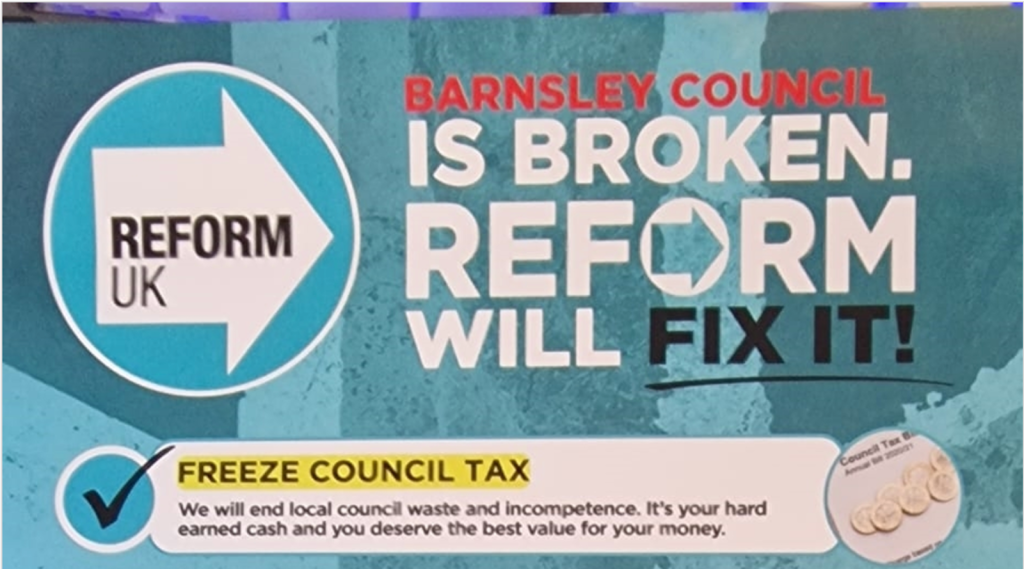
Across the coalition spectrum, voters were disappointed in this as it shatters the illusion of Reform UK being an honest alternative to mainstream politics. For ex-Labour voters, raising council tax is emotive as it is viewed as a concrete cost of living relief. For ex-Conservative voters, it casts doubt on the competency and organisation of the party.
“They seems less responsible or organised … They need to be more honest and explain the contradiction properly.”
– Female, 49, Scotland, 2024 Labour
“He’s coming across as not trustworthy. And don’t blame me approach … its actually made me think twice, after this interview i’m going to do a bit of research on this”
– Female, 42, Yorkshire, 2024 Conservative
“it makes me feel different like let down and not wanting to support them … Dealbreaker what other issues have they promised to change and will not change, cant trust them now.”
– Male, 31, East Midlands, 2024 Labour
Participants were asked to read and respond to the following text:
Nigel Farage, the leader of Reform UK, has advocated for lower taxation of cryptocurrency investments and for establishing a Bitcoin reserve at the Bank of England. In a speech to the crypto industry, he said: “When it comes to your industry, then I am your champion.”
A businessman named Christopher Harborne, who has his fortune invested heavily in cryptocurrency, recently donated £9 million to Reform UK. He has also paid over £50,000 for Farage and staff to travel to the USA.
For many voters, this reinforced an existing belief in political corruption that they might not previously have attached to Reform. Additionally, it threatens Farage’s image as a “man of the working people”, particularly for working class participants. Using this argument might be complicated for political parties, as wider conversations about political donations swirl on, but this could be an effective voter suppression strategy for disengaged and cynical voters.
“He’s clearly looking after his mates. … It means views and priorities can be skewed in favour of donors”
– Male, 47, South West, 2024 Conservative
“It looks like a bit of a bribe … it looks like Nigel could possible be easily swayed”
– Male, 29, North West, 2024 Reform UK
A division is exposed amongst supporters: for those struggling with financial pressure, and many ex-Labour voters, this feeds a sense that Reform will protect the wealthy, possibly at their expense. Ex-Conservatives and those who support low-tax, low-spend economic ideology are unperturbed by these arguments or even actively support them. However, some participants also revealed a distinction in thinking between inherited wealth and wealth earned through work, suggesting there might still be some wealth tax angles that would appeal to them.
“I feel more negative as he should be fighting for the working person and not those with super high incomes”
– Male, 36, South East, 2024 Labour
“I like that he wants bright people to stay in the country and be taxed at a rate that’s appropriate but not punitive, it’s a win-win. … Inherited wealth is a scourge of society and I don’t feel those people pay sufficient but for people who have studied, developed, made things happen by their own accomplishments, I don’t think they should have to pay a higher amount”
– Female, 59, East Midlands, 2024 Reform UK
There are two more faultlines that we did not test formally, but which emerged naturally through prompts about anything that would turn voters away from Reform UK or the wider conversation.
For many voters from Labour backgrounds, the NHS is a non-negotiable social guarantee that should not be touched. These voters believe that Reform UK will improve their social security, whereas privatisation of the NHS threatens this. Although voters are not naive to the struggles facing the NHS, they view it as an important safety net that everyone can rely on, irrespective of circumstances. With many non-voters and disenchanted voters ideologically mismatched with Reform but up for rolling the dice, the NHS could be a red line. Female participants were particularly likely to bring this up as a concern organically.
“Imagine how much worse off we would be as an economy having to pay privately when people are struggling already”
– Female, 33, North East, 2024 did not vote
“I am a huge advocate of the nhs, this must remain free at point of need. I feel we would lose our identity as a caring nation without it”
– Female, 57, East Midlands, 2024 Conservative
More than one party has a claim to represent working people better than Reform, through support for workers’ rights, reforms to the rental system or advocating for a fairer tax system. However, risk areas include welfare support and the impact of immigration on the economy. With Reform scapegoating immigration as a source of all economic ills, representing working people has become harder and more divided. Rather than questioning who actually benefits from the way the economy is run, people feel they are losing out and are encouraged to blame others. Crucially, doubling down on anti-immigration status will not help this, but talking more openly about non-welfare support measures will.
The deeper challenge ahead
Anti-politics sentiment and a deep feeling of dissatisfaction and distrust with politicians, especially the current Labour Government amongst Reform voters, means that even those with distinctly un-Reform political attitudes are willing to give Reform a chance. For example, the participants quoted below are most likely unaware of the current Government’s track record on renters and employment rights, NHS funding and nationalisation of passenger railway services. There is clearly a communications problem from Labour, but also a trust problem between parties and the electorate.
“i would give him [Farage] a chance to improve the UK economy … additional funding to the NHS and to provide more help and support to working families when it is needed … cut the high increases in rent and provide more support to help people get on the property ladder”
– Female, 35, North West, 2024 did not vote
“I think in an ideal world all public services should be publicly owned. When a business is privately owned it is run for profit not for people, if they where publicly owned then the money would be reinvested for the good of the people – but in saying that you would need an honest people focusing government – and we dont have that”
– Female, 46, Yorkshire, 2024 Reform UK
Hopeful interview participants talk about raising the income tax threshold or lowering taxes as an economic change they expect to see immediately once Reform UK is in power. The party almost certainly cannot deliver this, and Farage himself has stated that tax cuts are “not realistic at this current moment in time”.
The question remains: where will struggling voters go, if they’ve left mainstream politics for Reform and their dice roll doesn’t pull off? Arguably, they will sink further into disengagement and distrust.
“they’ve shown they’re all as bad as each other, reneging on policy promises, taking freebies and handing out contracts to friends. The two party system hasn’t produced a decent government in thirty years so I’d be happy to give another smaller party the chance to see what they they could do because democracy isn’t working in the current political climate.”
– Female, 59, East Midlands, 2024 Reform UK
We’re lifting the lid on the people and money behind Reform UK, and this is just the start. Reform Watch is a new newsletter from HOPE not hate, sent straight to supporters who want to know the truth about the party. Sign up now to get the next edition.

Prefer to listen? Click the play button to hear the audio version. Harry Shukman Reform UK is staffed by oddballs and enigmas, but none odder…