Based on the turnout to his rallies in 2025 and 2026 in London, Stephen Lennon (aka Tommy Robinson) can still pull a crowd. However, there are signs in the online data that he is increasingly chasing ‘superstar’ status by swapping his UK roots for a much bigger American stage.
The data is clear: Lennon has made a calculated pivot, leveraging American focus to boost a global far-right brand that thrives on the international political circuit. This was compounded by his US tour earlier this year, landing him a re-platformed, warm welcome from the Trump 2.0 administration. Together with platform-backing from Elon Musk, Lennon now has open-access to a lucrative expanding international market.
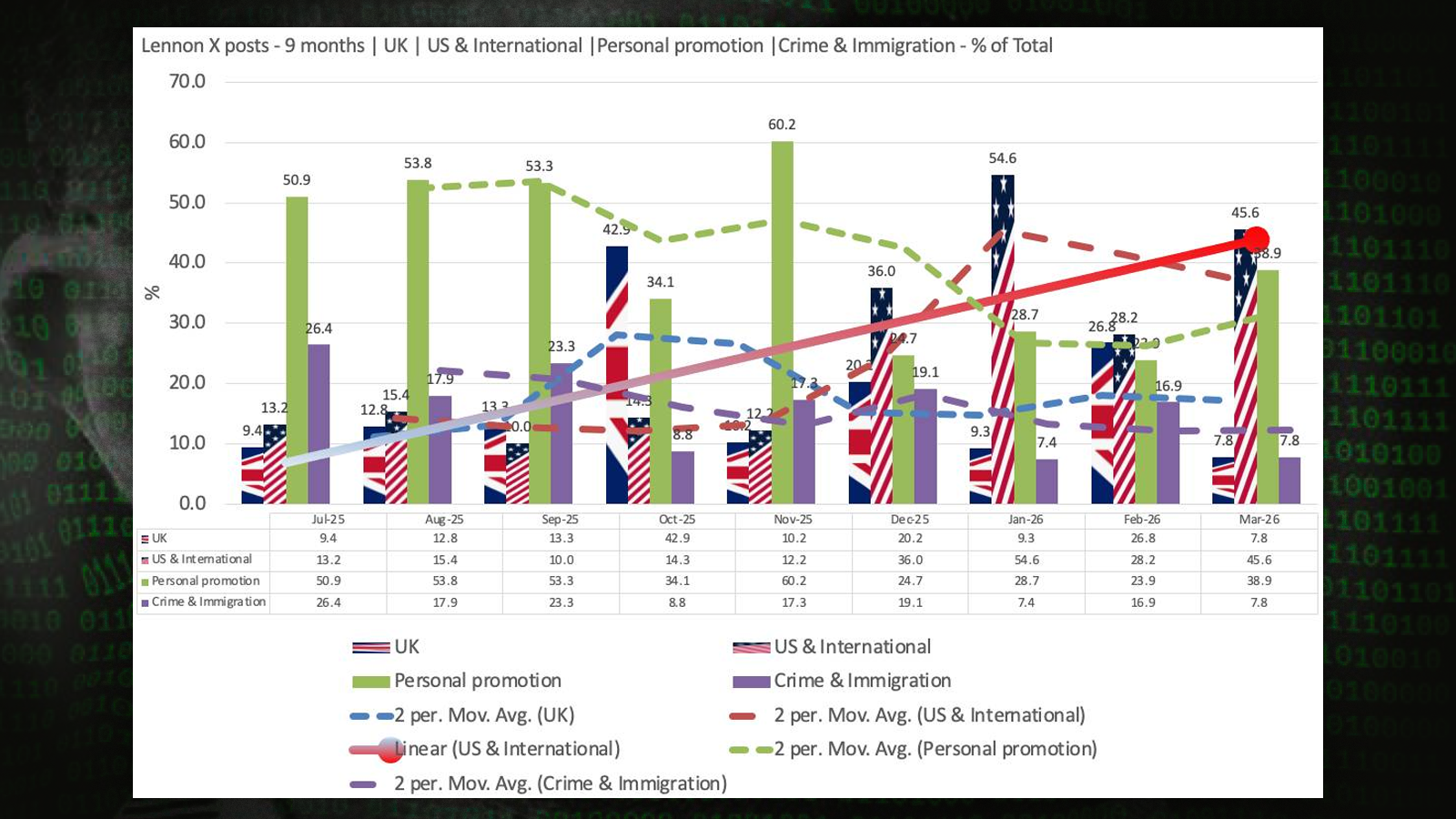
Our Data Desk analysis confirms this: His UK-focussed content on X collapsed from 43% in October 2025 to under 10% in March 2026, while his US and international-focused content surged past 45% over the same period. However, his recent far-right voter registration drive exposes a potential new strategy, hinting that his American connections may be engineered to serve, rather than supplant his waning domestic political ambitions.
The data also shows that Lennon’s personal brand continues to eclipse all his substantive content at 40% of his online output, while six in seven of his most viral posts in March 2026 concerned US or international issues, not Britain.
Critically, his US pivot has started to erode his domestic standing and in 2026, in the majority of his posts, for every person backing his calls there is now an opponent. On average, in his own rally propaganda posts, supporters (35%), are outnumbered by opponents (52%). And among his most extreme “remigration” base, up to 63% now oppose him for not being radical enough, rejecting his performative protest in favour of direct action, with some openly calling for port blockades at Dover and Kent coasts.
The “grift” accusation is also becoming a more prevalent feature in the data. In a 2026 post advertising his latest rally, 13% of comments explicitly labelled his operation a “grift”, with one follower asserting “He wants your f*cking money. That’s it”. Lennon’s traditional audience increasingly recognise that his model of merchandise-driven performative protest is designed to vent, not enable real change and they are rejecting it.
Our data also confirms that the platform dynamics are equally dire. Despite the Online Safety Act, violent unmoderated content (including within Lennon’s own comments section), continues to proliferate unchecked on X, where algorithms perversely reward combative content, amplifying Lennon’s reach even where people disagree with him.
This report quantifies these dual perspectives in the data to definitively answer whether Lennon’s recent American focus is a permanent detour, or a strategy for longer-term political ambitions at home. And more crucially, what his hard-line followers have to say about it. Our analysis takes a deliberately simple, robust and mathematical approach, literally counting and measuring Lennon’s online footprint over the last three years.
While the data picture is complex and continually unfolding, one thing is clear: whether Lennon is an American stooge or a UK far-right poster-boy, or both, our analysis shows he is definitely a transnational entrepreneur peddling manufactured grievance, and his followers are beginning to see through that.
of his X content focused on the UK by March 2026 — down from 43% in October 2025
now focused on US and international issues
Lennon’s most recent demonstration in London earlier this year, drew a crowd of almost 60,000 people. Substantially smaller than in 2025, it highlighted some early but sustained signs that Lennon’s far right ecosystem may be fracturing; sold off for an international audience and, where he is growing in influence. While the event focused on a predictable rejection and vocal attack of Keir Starmer’s Labour government, the actual mechanics of the rally exposed a much deeper structural shift.
The analysis in this report provides a balanced view of the long-term trends emerging from our online data analysis over three years, grounded in the reality of a volatile, fast-moving online and real-world environment. The data points to structural shifts within Lennon’s online ecosystem, alongside episodes where his capacity to mobilise followers drives temporary surges in his reach and impact, which has opened the door to his more vocal and activated critics. This dual perspective, designed into our analysis below, allows us to identify which patterns are stable over time, which are driven by short-term mobilisation, and how these dynamics interact to shape the evolving landscape of his influence.
On the day of his protest, Lennon openly boasted of six-figure cash injections from American donors and corporate sponsorships, making clear his focus on the highly lucrative, US-style political circuit; his “global grift” packaging genuine domestic anxieties into commercialised outrage. Strategically positioned on a huge stage in front of Parliament and live streamed across several social and mainstream media channels, his ‘show’ was tailored for wealthy foreign backers and unmoderated online platforms where sensationalism converts directly into cash.
The lineup on stage was a bizarre, disjointed circus featuring everything from AI-generated rappers and sensationalist stunts by foreign national groups to fringe religious figures. On one hand, literature distributed throughout the crowd by rival extremist factions was explicitly extreme; on the other, online commentators accused Lennon of selling out his British roots for American personalised brand clout.
The reality on the ground quickly exposed the absence of any meaningful policy content. Things kicked off early with the high-profile arrest of a prominent fringe group leader right outside Euston station, picked up by police in connection with a hit-and-run incident that had left a person with a broken leg. On stage, the spectacles were designed for maximum shock value rather than coherent policy; at one point, a French identitarian women’s group walked out clad in full niqabs, drawing immediate boos from the confused crowd until they coaxed the audience into chanting for them to strip the garments off before starting their speeches.
Meanwhile, the true nature of the crowd was reflected in a series of grim videos circulating online, capturing blatant hate incidents that completely contradicted any claims of peaceful protest. These included a man being filmed kicking a bystander in a keffiyeh while branding him a terrorist, alongside multiple instances of raw racial abuse hurled directly at police officers on duty. Some foreign donors may see a global statesman, but Lennon’s former allies and grassroots supporters increasingly see a grifter.
Online, a lack of content moderation on Lennon’s preferred platforms means he doesn’t need to soften his tone or content to get traction. He’s scaling up exploitation of the international funding pool that values outrage over accuracy, but recently this approach seems to be drawing heavier criticism.
The entire event was broadcast over social media, a medium which has been fundamental to the rise of Lennon. It now allows him to reach vast audiences, previously impossible for far-right figures. Like others, he has used it to disseminate his hateful politics, radicalise and recruit supporters, create a global network and raise money. There was a period when social media clamped down on the far right but in the last five years, they have rowed back on this, meaning figures like Lennon have been able to reach new heights of influence.
This is having a very real effect on our streets and in our communities. It has allowed him to organise the biggest ever far-right protest but also become even more of a global figure. Lennon is a key node in massive international online networks. The content shared in these networks is having a polarising and radicalising effect which is spilling out onto our streets via protests and even riots. This has been recognised by lawmakers resulting in action like the Online Safety Act (OSA). However, despite all this, social media platforms are still fundamentally failing to take action to limit the spread of hate by figures like Lennon. This begs the question, is OSA fit for purpose?
In our State of Hate 2026 report, we showed how Lennon and his supporters use tactics to amplify propaganda and disinformation, including leaning on international sponsors, like Ezra Levant and Elon Musk and using AI tools like Grok to boost messaging. This new analysis looks at whether these tactics are working on the ground and tests if his new US and international focus in 2026 still resonates with the British public.
At the same time, to understand the broader implications for online safety, social cohesion, and content moderation, we’ve analysed where these perspectives originate, who’s amplifying or supporting this type of messaging and who is pushing back against it. We’ve looked at how these narratives are evolving over time, the level of traction they are gaining, and what this indicates about the wider trajectory of Lennon’s brand as he increasingly courts US sponsors - even Lennon’s closest team are talking about the US:
“The American situation is so relevant to what’s going on now. It has to be done”
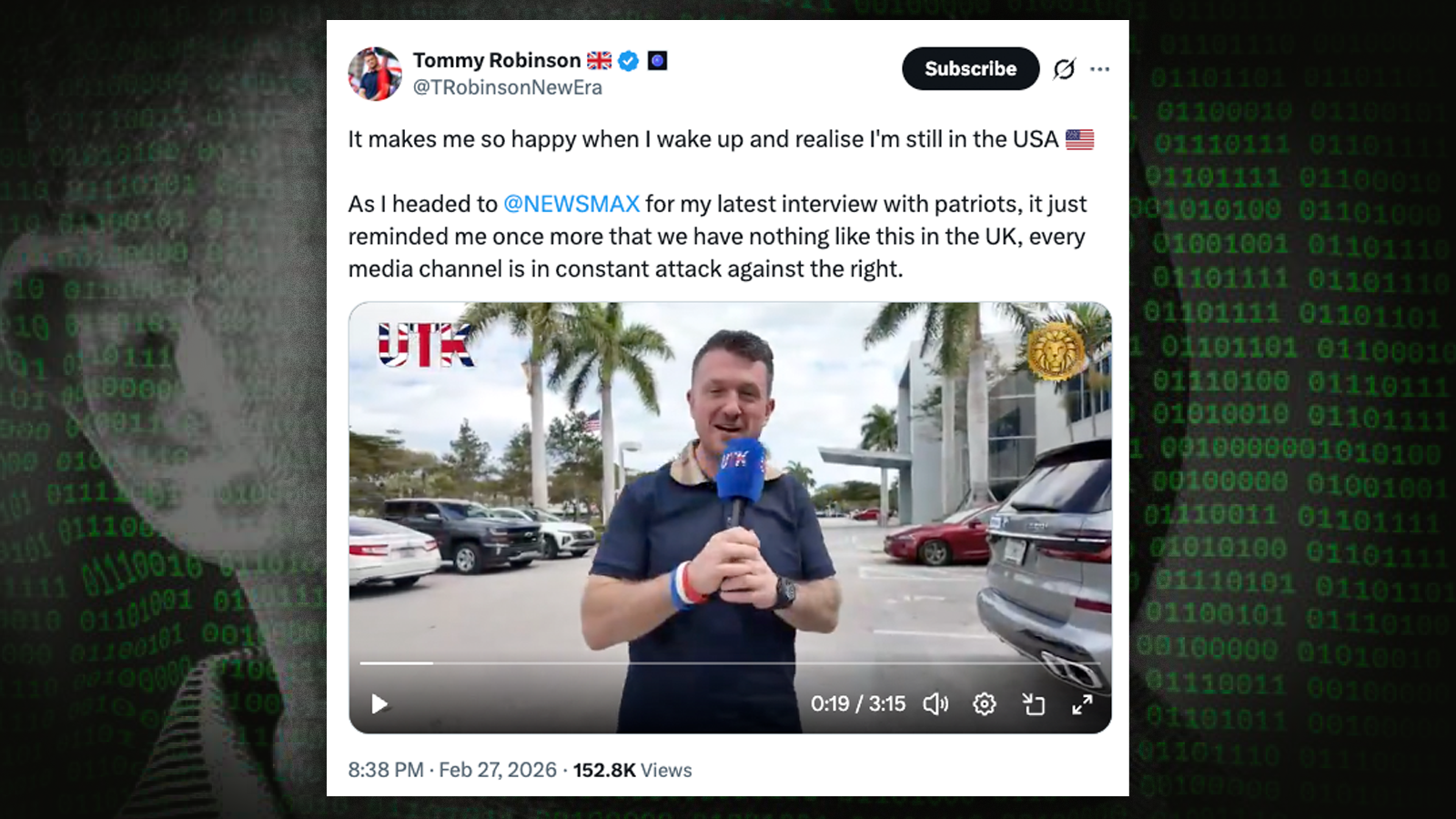
Lennon has turned his political movement into a business. While he has long been a significant figure in the international scene, he is now more consciously targeting the US to exploit the global shift towards the far right.
On the face of it, his follower numbers look impressive, and he’s got wealthy backers from overseas, but when we look into online behaviour and public attitudes, a different story emerges. His pivot to the US appears to be impacting his engagement in the UK. For example, In 2026, our analysis shows that for every person backing his calls to action, there’s now an opponent. The engagement of his supporter base is changing, with his own followers increasingly frustrated with the new messaging he’s putting out.
“In 2026, for every person backing his calls to action, there’s now an opponent”.
For all his “patriot” talk, Lennon increasingly conflates his UK advocacy with wider international and US content. While this is certainly amplifying his reach, it’s getting a mixed reception from his traditional follower base.
Lennon’s ongoing courtship of the MAGA world, his visits to the US and the growing prominence of US themes in his content all point towards a figure who is desperate to exploit opportunities across the Atlantic.
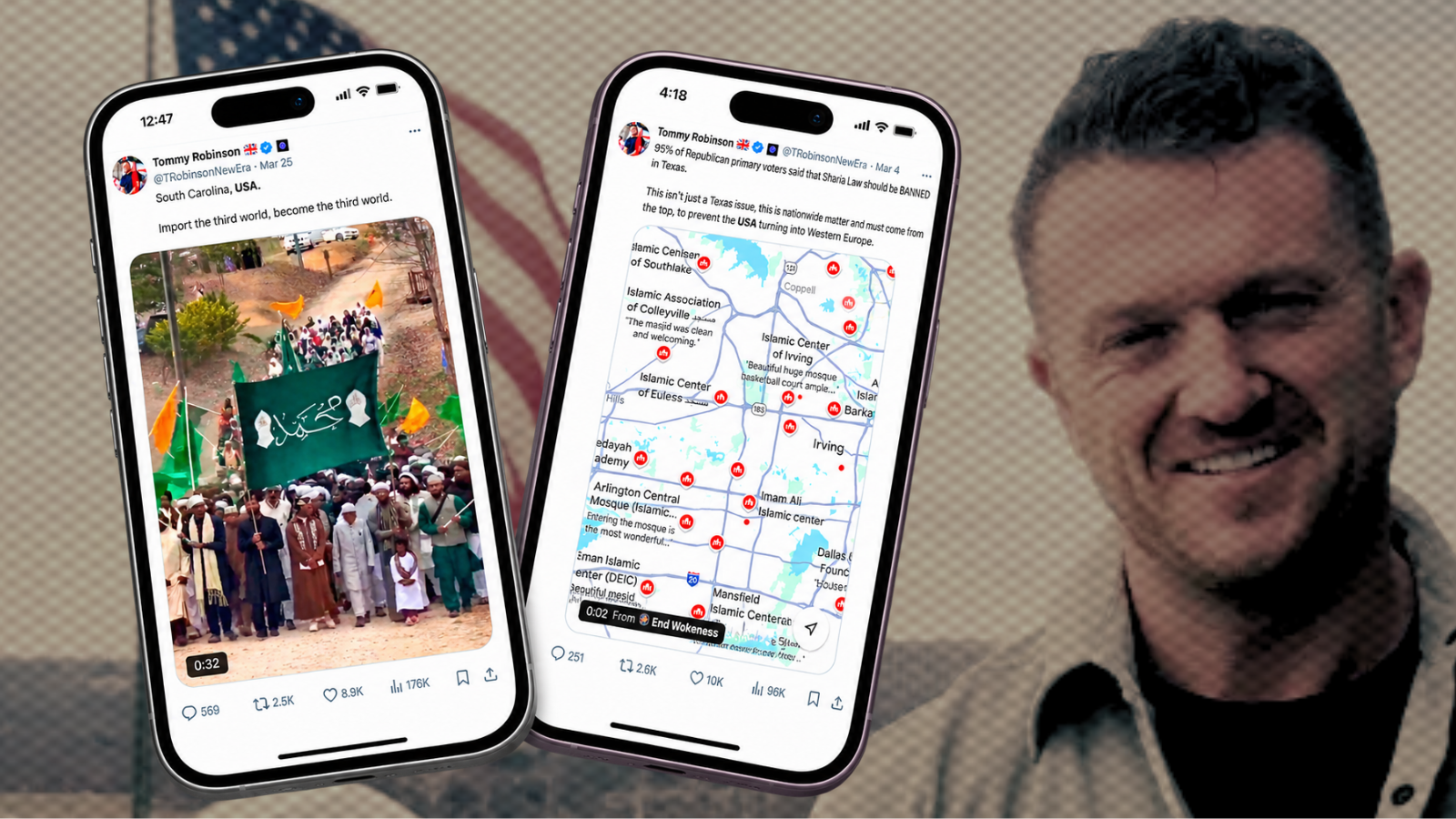
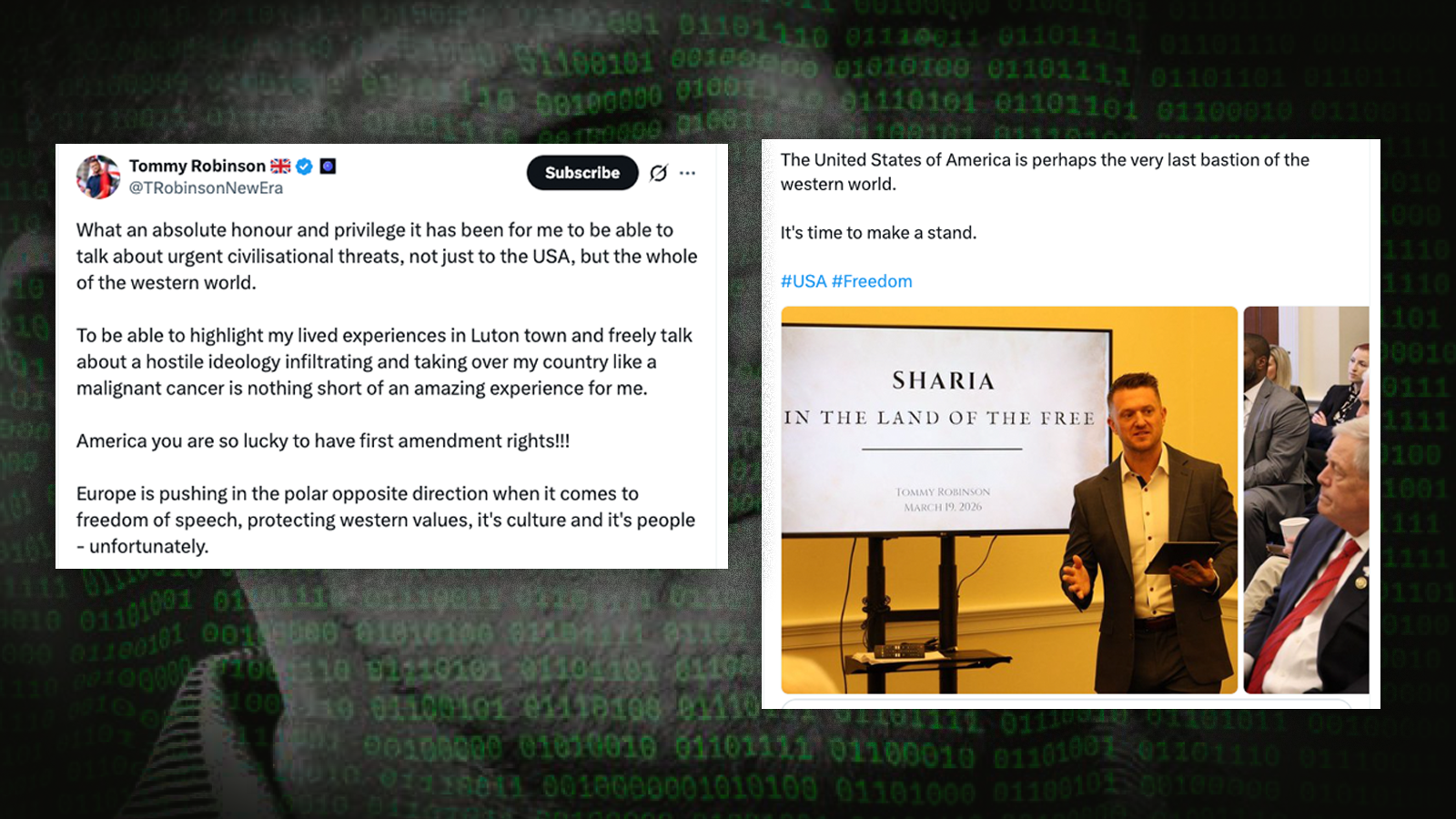
However, our analysis shows this is a more complex picture, with evidence suggesting that this shift has been gaining traction since around 2020 and the Covid pandemic when he began posting (later discredited) videos online linking the spread of the virus with Muslim communities. While this realignment has more recently been super-charged, its roots are deeper than recent activity suggests, indicating that this is a longer-term strategy rather than a recent conversion. Even back then, this included manoeuvring and tilting his narrative towards a US audience, pushing back on lockdown measures to appeal to a wider audience leveraging US-style public freedom and civil liberties angles. In November 2020, he was arrested at an anti-lockdown rally in London as he adjusted his model from defending the UK from Islam to defending freedom from the state. Here are two of his posts from August 2026:
At first glance, Lennon’s attention towards the US would seem to indicate that he has abandoned his UK base in favour of more lucrative opportunities across the Atlantic: a British activist, praised by Trump allies, raising funds from American donors and tailoring his message for a Stateside audience.
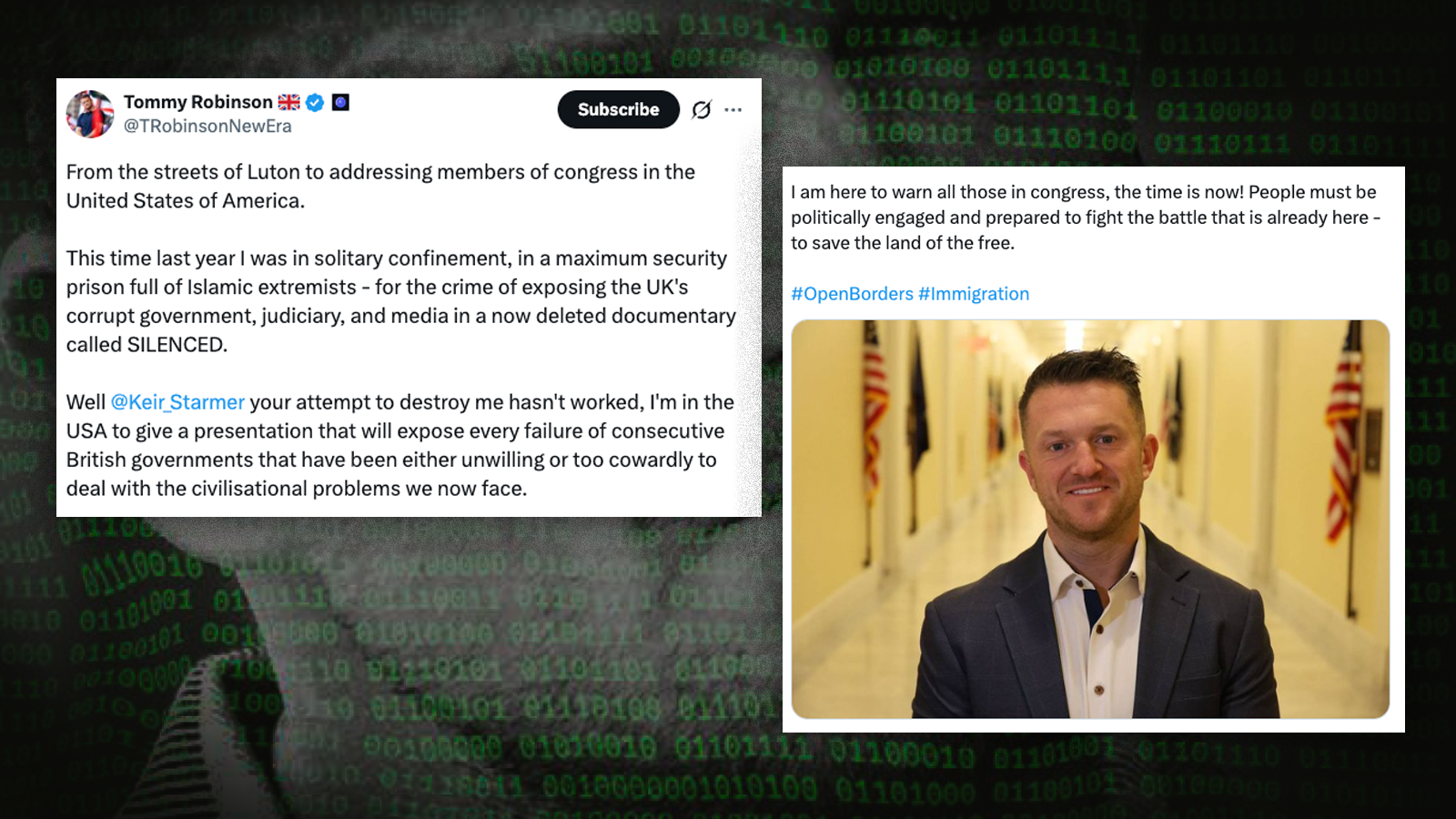
Yet this surface analysis may be an oversimplification. The question of whether courting foreign audiences and foreign cash necessarily comes at the expense of his UK base is less clear. If we take his stated intentions at face value, his declared priority for the next three years is a voter registration drive, an explicitly UK-focused project. Significantly, this initiative is likely to be bankrolled by US money, suggesting that his American connections may serve, rather than supplant, his domestic political ambitions. What looks like a pivot away from the UK may in practice be a strategy to leverage US resources for UK ends.
Social media data is rarely as straightforward as it first appears. Content categorisation, distinguishing between “US-focused” and “UK-focused” material, is inherently subjective and can be misleading. A single video may address a US audience while discussing UK issues, or vice versa.
Although our findings suggest some erosion of online support for Lennon, it is important to note that the evidence may point to a discernible shift in the far-right ecosystem, rather than a straightforward displacement of Lennon. In other words, a shift away from Lennon as the sole figurehead towards a more fragmented landscape where younger influencers command significant attention and authority online. At the same time, it is clear that the UK far right movement as a whole is expanding, with overall numbers being drawn towards it, whether to Lennon, Restore Britain, or others and continues to grow.
What is clear, is that Lennon is starting to lose control of his own comments section. Where before he enjoyed overwhelming support for his content on X, by August 2026, (with barely 10% of his content on specific British issues), the people arguing with him in his own replies outnumbered the ones cheering him on (52% vs. 35%). This might be because nearly 40% of his content routinely has a personal promotion or fundraising angle. His own followers have noticed this, and in analysis of a recent rally propaganda post, nearly 13% of the comments called his operation a “grift.”
It’s also clear from the data that there is an emerging more radical element of the far right that are increasingly vocal in calling Lennon out as a fake and this could be his biggest challenge. Our analysis of one of his Unite the Kingdom rally propaganda posts on X (March 2026) shows that among his follower accounts that push for “remigration” (mass deportation), almost two-thirds (63.2%) now oppose him. They don’t think he’s gone too far, they think he isn’t going far enough or has sold out. While his followers look to him for patriotic mobilisation, they instead get commercial appeals. They look for leadership; they find a ‘grifter’ courting American sponsors. They demand direct action but are offered a symbolic ‘day out’ while his attention drifts to topics that please US patrons.
In October 2025, Lennon’s content about the UK spiked at 43%. By March 2026, that had crashed to under 10%. Meanwhile, his posts on US and international politics shot up to over 45%. His biggest viral hits aren’t about British streets anymore. They’re about American culture wars. He’s building a brand for overseas donors, not fighting for British followers. However, as we outline below, this remains a complex picture.
“His biggest viral hits aren’t about British streets anymore. They’re about American culture wars”.
What a f***ing grifter. Trying to sell his merch for the event, then the buckets come out, then the QR codes.
Lennon is definitely winning on reach; his online audience has grown exponentially, and he can mobilise support for his rallies, but he’s losing on resonance. He’s traded the hard work of UK activism for the easy money of US-funded outrage. This report shows that he’s leaving behind a fractured, frustrated, and increasingly radical movement that isn’t really listening to him anymore. Worryingly, some of them are now openly talking about civil war and remigration which again, raises serious questions around the Online Safety Act.
Lennon has become a key figure in the online global far right. He has been remarkably successful at exploiting the many new opportunities provided by social media and an effective adopter of new forms of digital far-right activism.
HOPE not hate have long talked about the power and danger of the ‘post-organisational’ online far right. Thousands of individuals, all over the world, now offer micro-donations of time and sometimes money to collaborate towards common political goals, completely outside traditional organisational structures. These movements lack formal leaders but are best understood as a many-headed hydra. Lennon is one of the most important and prominent such-figureheads. These movements are genuinely transnational with activists from all over the world coming together for short periods to collaborate on certain issues with these loose networks acting as synapses passing information around the globe.
Within these networks, key figures operate as central nodes, cherry-picking and disseminating content from around the world that bolsters their existing narratives. Lennon is one such ‘super sharer’ (an especially influential activist with a large social media following) which he exploits to peddle ‘evidence’ making the case around the threat of ‘Islamification’. Here, Lennon plays a dual role. He takes stories from around the world and feeds them to his own audience. At the same time, he is happy to target international audiences by presenting a distorted and inaccurate picture; talking down the UK to the rest of the world.
On one hand, there are some indications that Lennon’s dominance and impact is diminishing; but on the other hand, these trends are complicated by a rapidly evolving far-right ecosystem and the algorithmic features of social media. To explore the interplay of these factors and trends in more detail, our Data Desk report brings together two things: what Lennon is talking about in 2026 and how his followers on social media are responding to him as he prioritises his new American audience.
The global pivot: Analysing Lennon’s divergent digital reach and internal friction
Our report investigates the evidence of Lennon’s strategic shift toward US and international commercial sponsors. By analysing online behavioural data and sentiment within his own comment sections, we examine the growing internal friction: while some see a global statesman, others, including former allies, increasingly view him as a “grifter” whose brand is no longer “extreme enough” for the domestic hardline.
Researchers and journalists can also read the full technical annex (PDF).

A HOPE not hate Data Desk report · August 2026