Prefer to listen? Click the play button to hear the audio version of this article
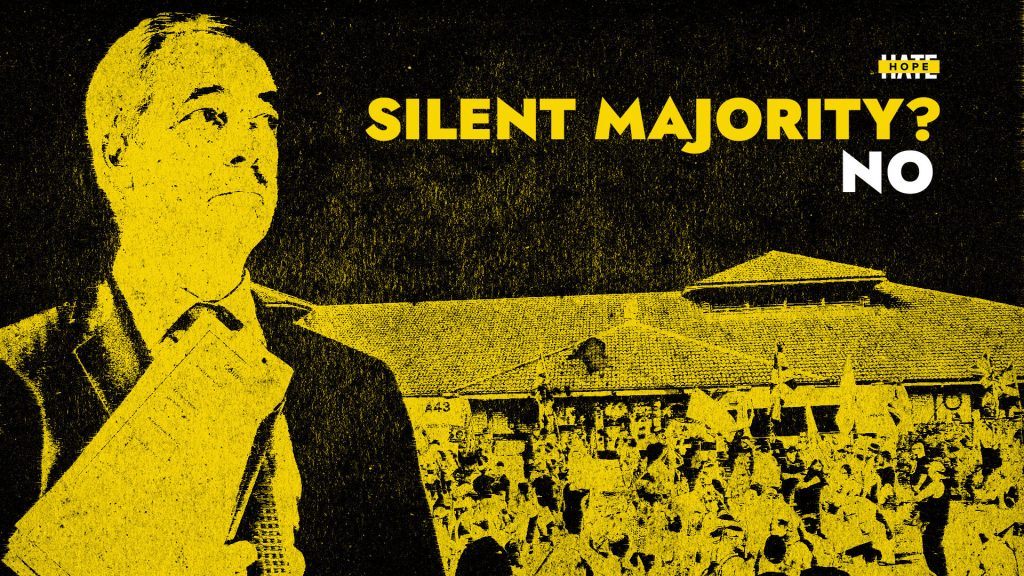
On both social and traditional media it’s easy to find commentary claiming that Nigel Farage’s extreme deportations policy and the recent series of anti-migrant protests represent the will of the British people.
Writing in The Sun, former academic turned Reform UK supporter Matthew Goodwin said, “What they [protestors] are tapping into is a groundswell of entirely legitimate anger and frustration,” accusing Keir Starmer of being, “tone-deaf to the mood of the nation”.
For Goodwin and his ilk, we are witnessing an “uprising” and are encouraged to believe that the small groups standing outside hotels housing asylum seekers are the true voice of the silent majority. They represent “the mood of the nation”.
This view is also popular amongst the protestors themselves, with one in Bournmouth recently telling the BBC, “We just feel we need to stand up and be counted — we are the silent majority, we’re not racist or far right.”
Part of the problem stems from the media’s exaggerated coverage of the current anti-migrant protests. Last weekend there were indeed a large number planned across the country, resulting in a raft of headlines about a “wave” of nationwide protests “as tensions soar”.
Yet few, if any, reported that a significant number of announced protests never materialised and the majority that did saw fewer than a hundred people attend. HOPE not hate’s analysis of the weekend, based on a combination of press reports, live stream, image and social media analysis, estimates that a maximum of 4,000 people protested across three days. That’s still worrying, but it’s hardly the “uprising” predicted by many on social media.
Worse still, elements of the media have gone further than merely talking up far-right activism and have occasionally repeated its talking points. This week, Sky News published a widely-criticised article titled “Is it time for gunboats to help stop the people smugglers?” which argued that people are “demanding bolder and more radical measures from the government”.

It’s little surprise that Steve Laws, one of Britain’s most extreme far-right activists, recently posted on X: “Everything is moving in the right direction. Even the mainstream media are echoing our talking points.”
A Vocal Minority
In truth, Farage and the hotel protests don’t really represent the “silent majority” but rather a vocal minority. Inaccurate framing by elements of the media and commentariat are exaggerating the popularity of extreme and fringe far-right views while simultaneously normalising them.
In truth, recent polling shows that the British public are far more nuanced on the issue of immigration and even cross-Channel boats than Farage and his supporters would have you believe.
When Ipsos asked if “people should be able to take refuge in other countries, including in my country, to escape from war or persecution”, 71% of British people agreed, with just 21% disagreeing. It’s true that sympathy for people crossing the Channel by boat is more polarised, but even here 46% of people retain a “great deal/fair amount of sympathy” compared to 47% with “Not very much/no sympathy at all”.
There’s no doubt that immigration remains a major issue in the eye of the public, with 48% naming it as an important issue in the Ipsos poll. That is an eight-point rise since July. But public attitudes don’t exist in a vacuum and this rising concern will, in part at least, be affected by the media’s framing of the issue.
When it comes to the hotel protests, they also receive much less support than you might think. The public is clearly divided with 36% deeming them acceptable and 39% unacceptable.
Similarly, when Farage announced his extreme deportations policy and pledged to leave the European Convention on Human Rights this week he said: “As far as the people of this country are concerned, frankly these measures can’t come soon enough.”
That’s simply not true. According to YouGov, 51% of people think Britain should remain in ECHR, with just 27% believing we should withdraw. When you break this down by party affiliation, the divide becomes even starker with 72% of Reform supporters wanting to leave while 75% of Labour and Lib Dem supporters wanting to remain.
Populists have always been good at presenting their fringe and extreme views as common sense, claiming that they are speaking for “the people”. But they don’t and the media shouldn’t let them get away with it.
So Why Is Reform Leading?
If all this is true, then why is Reform currently leading the polls? Recent research by HOPE not hate has offered valuable insights here and the picture, again, is a complex one. Reform’s voter base is far from a single bloc only concerned with immigration, but rather it is a coalition of people drawn together by its promise to “fix the system”.
While a core of Reform’s support is indeed primarily based on concerns about immigration there is real nuance across the base. Viewing Reform supporters as a homogenous mass is a mistake. The polling showed a segment of its support have neutral or even positive attitudes to immigration.
This reveals the futility of Labour’s current strategy which appears to be one of attacking Reform from the right. In response to Farage’s deportation speech, Labour released an image framing Farage as “shouting from the sidelines” while Starmer has “removed 35,000 people from the UK with no right to be here”. This coming off the back of his “island of strangers” speech and Trump-esq social media videos of deportations.
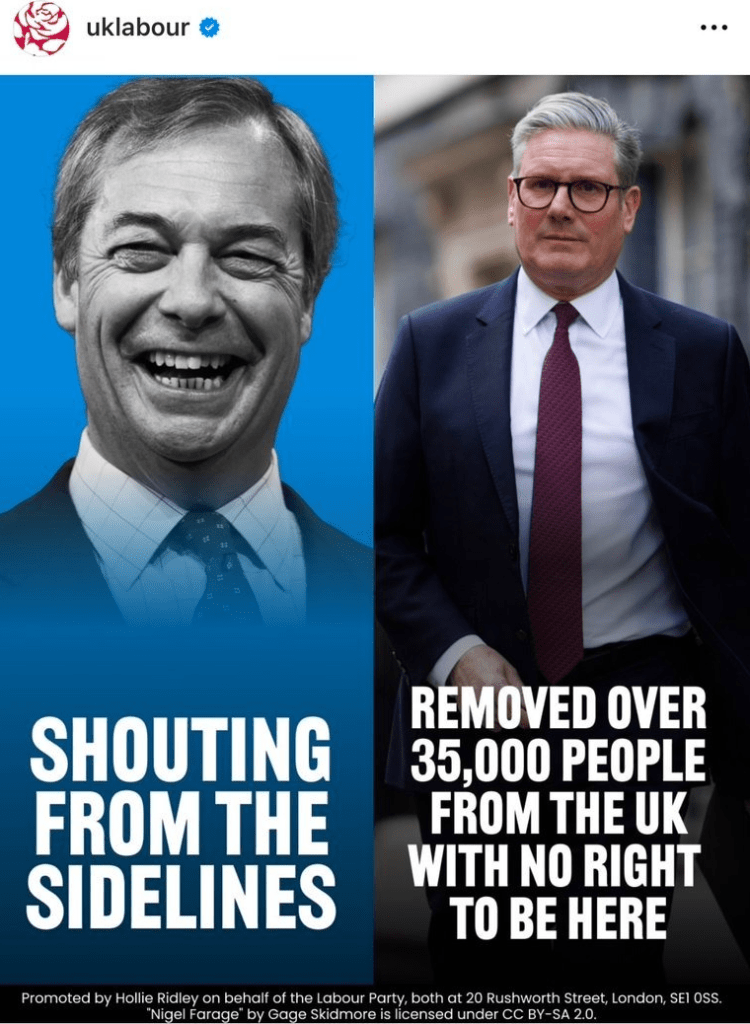
The lessons of the past two decades across Europe are clear. Social democratic parties that shift rightwards to head off a threat from the radical or far right end up losing. If Labour continues to try and occupy Reform’s space with ever more right-wing rhetoric on immigration and asylum seekers, this will only serve to legitimise Reform’s politics, increase their salience and ultimately boost its electoral success.
None of this is to downplay the very real danger currently posed by the far right. It is growing in both number and strength. We saw the horrifying power of the politics of hatred last year when Britain erupted in the most widespread period of far-right violence of the whole postwar period. Street protests are growing in number and Reform, a populist radical right party, is topping the latest polls.
However, it is possible to sound the alarm about its threat without simultaneously framing the far right as the voice of a “silent majority”. They are not, and doing so will only accelerate its rise.
Prefer to listen? Click the play button to hear the audio version. Harry Shukman Reform UK is staffed by oddballs and enigmas, but none odder…