For decades, activists of the German far right have dreamt of a powerful and influential political party. Several extremist parties – like Die Republikaner and…
For decades, activists of the German far right have dreamt of a powerful and influential political party. Several extremist parties – like Die Republikaner and the Deutsche Volksunion but, most recently, also the nazi National Democrats (NPD) – were able to campaign successfully and to secure election to regional parliaments since the late 1980s but none could jump above the 5% hurdle in national parliamentary elections.
The Alternative für Deutschland (AfD/Alternative for Germany) seems to be a different story. Founded in February 2013 by a group of 18 men of advanced age, its most important issue at that time was heavy criticism of the Euro bailout policy in the wake of the financial crisis from a nationalist perspective.
Only months later, in September 2013, the party took part in the national elections. While narrowly missing entry into the Bundestag with 4.7% % of the vote, the AfD nevertheless achieved the strongest result for a new party at federal level since 1953.
What followed was a right-wing success story that has brought the party into 13 out of 16 regional parliaments so far with the national elections approaching and the AfD standing at 8 to 9% in the polls.
In its early days, the AfD drew its activists from different backgrounds: the neoliberal right, national-conservatives, the fundamentalist Christian and the far right. Its history is a history of constant infighting and a relentless move to the right. As a result, thousands of conservative and neoliberal members have quit the party and, as of July 2017, only four of its founding members remain.
Others came in instead. For example, in September 2013, René Stadtkewitz, then leader of the small anti-Islam party Die Freiheit (Freedom), urged his followers to support the AfD.
The weekly Junge Freiheit, long a vocal expression of the far right in Germany, and the monthly magazine Zuerst! operated by Dietmar Munier, a long-standing right-wing extremist with a history in the NPD’s youth organisation, also promoted the party. In March 2014, the Thuringian AfD official Hans-Thomas Tillschneider was prominently involved in creating the Patriotic Platform as a particular interest group in the AfD that has become a powerful force in pushing the party further to the right.
Years of scandals and constant internal struggles have done little significant harm to the AfD. Indeed, every time it has taken part in elections since 2014 it has done so successfully.
In particular, it profited from the huge number of refugees arriving in Germany in 2015, during what was viewed by a majority of the population in Germany as a severe political and social crisis. The party is still aggressively campaigning and making use of the financial and organisational resources it has gained from its electoral successes.
So far, democratic forces have not found a proper answer to the AfD. As a result, for the first time since 1961 a right-wing populist party with a strong far right wing will enter the national parliament on 24 September 2017.
This can only mean more hate to come.
Prefer to listen? Click the play button to hear the audio version. Harry Shukman Reform UK is staffed by oddballs and enigmas, but none odder…

HOPE not hate reveals the key figures behind Raise the Colours, exposing their criminal histories and their intimidation of local people. Unite the Kingdom attendees…
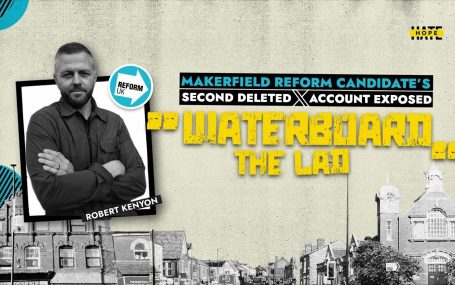
By Paul Kershaw and Sarah Hadley On a deleted social media account, Reform UK’s candidate in the upcoming Makerfield parliamentary by-election, Rob Kenyon, made creepy…