
by HOPE not hate Data Desk
OUR ANALYSIS over the past 12 months reveals that the Lennon online ecosystem has attempted to professionalise. What used to be a source of fragmented shouting has become a high-frequency and confrontational disinformation machine.
Using more than 13,000 posts and replies from social- media platform X over the last year, our Data Desk analysis shows how Lennon now operates less like an activist and more like a media mogul. We have also analysed 1,750 key interactions within his ecosystem, to show how he has built an online “digital spectacle” using disinformation, AI and high-profile international backing to inflate his brand. This helps him and his supporters blur the lines between genuine grassroots grievance and the performative victimhood that brings him maximum algorithmic reach.
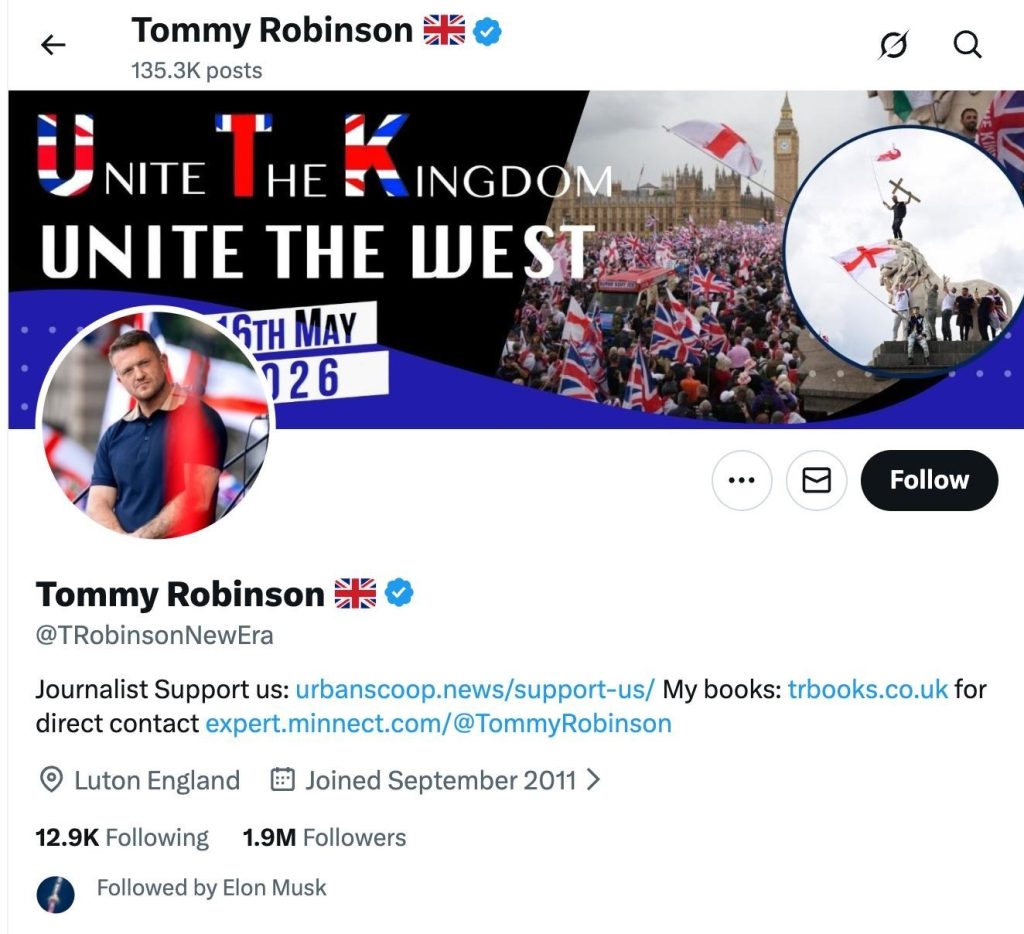
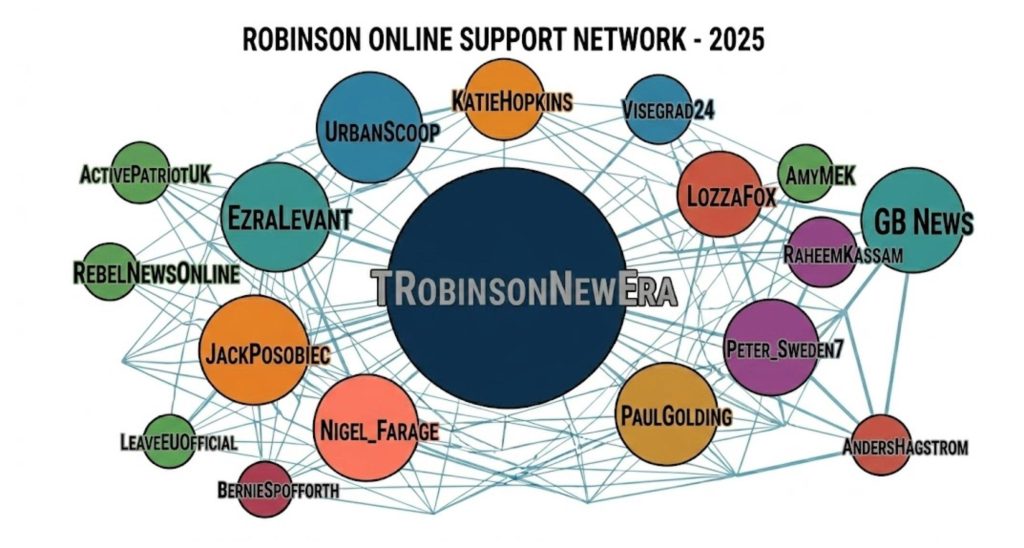
Data shows that while Lennon’s online presence is massive, much of his influence is actually the result of a small, insular group of online supporters. As such, much of his growing online reach is driven by an influential network of key figures rather than being a sign of growing public support. Lennon acts like a “weathermaker”, stirring up a lot of noise and making his current followers more extreme, but he isn’t really winning over new people. Even though he seems more visible than ever, he’s mostly just ranting into the same echo chamber.
KEY FINDINGS
1. SMALL, AND MORE CENTRALISED THAN YOU’D THINK
Our analysis indicates that Lennon’s online operation is far smaller and more centralised than it first appears. Rather than a broad-based grassroots movement, Lennon’s online network actually functions as a broadcast system in which a tightly connected inner circle drives visibility and reach. Just 20 accounts, excluding Lennon himself, are responsible for 36.8% of all retweet activity within the pro-Lennon echo chamber. This concentrated amplification acts as a force multiplier, creating the illusion of widespread, organic public support while masking the movement’s underlying dependence on a small, coordinated elite. While individual accounts can be replaced if removed, the overall structure remains fragile, leaving the movement far less resilient than it appears to the average X user.
2. HIS USE OF GROK
Lennon uses Grok as a form of digital notary, exploiting the AI tool’s perceived objectivity to manufacture trust. Posts featuring screenshots or outputs attributed to Grok generate an average of 5,311 engagements, compared with a baseline of 1,599 engagements for posts that do not reference Grok, representing a more-than-threefold increase in interaction and a conservative uplift of at least 215%. This “trust-multiplier” effect appears to allow Lennon and his network to short-circuit scepticism, with followers treating Grok’s outputs as neutral verification rather than as generated content. Lennon and his supporters use Grok to “cool down” aggressive content. By repackaging deeply negative posts, sentiment scores shift from a volatile -0.82 to a near- neutral -0.08 so they can bypass Online Safety Act regulations while keeping their core message intact, significantly amplifying their reach and credibility within the pro-Lennon ecosystem.
3. WHAT HE SAYS AND WHAT HE ACTUALLY DOES
Despite the loud presence of Lennon’s movement online, there is a massive gap between the internet “noise” he creates and his real-world results. While rallies and posts might look impressive, the actual “potency” of the group is surprisingly low at just 0.61%. This means that for every 100,000 likes or shares, only about 610 people are actually talking about specific policies or taking meaningful action. For the most part, the movement acts as a performance for people who already agree with his message, rather than a platform for political change.
Our data analysis confirms that while the movement is great at grabbing attention, it struggles to turn that energy into progress. It enjoys high visibility and momentum on social media, but it lacks “organic potency” – the ability to convert digital noise into a serious political force. It functions more like a spectacle or a piece of social-media “theatre” than a traditional political movement, prioritising being seen over any actual policy.
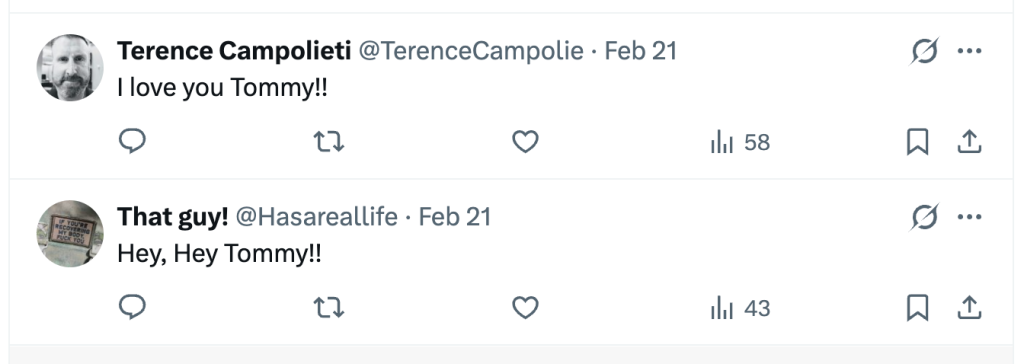
4. HIS INTERNATIONAL COVER
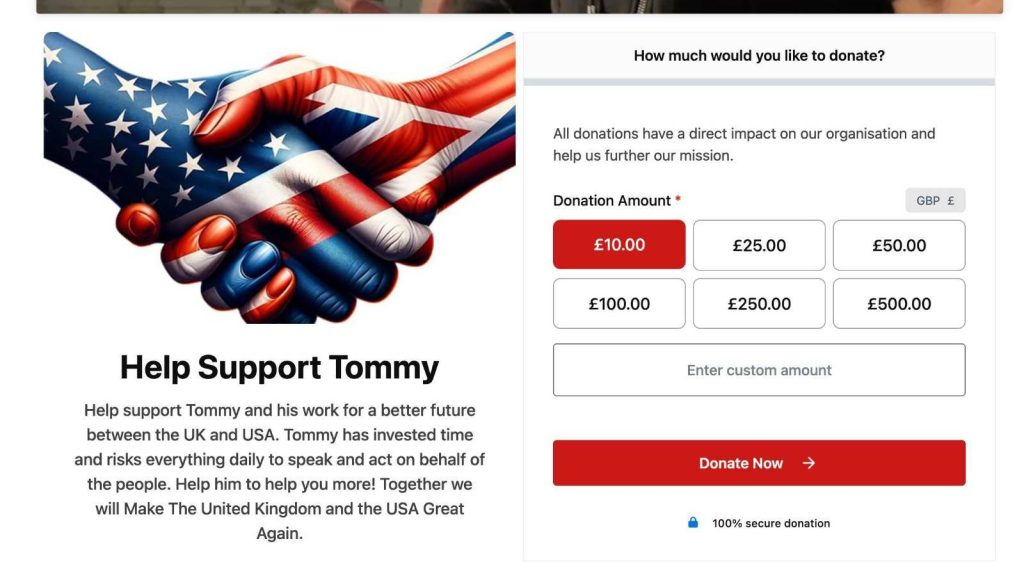
Lennon’s influence isn’t just confined to a British audience; he relies heavily on a massive support network from overseas. To take one example – a Canadian outlet, Rebel News, led by Ezra Levant, acts as a professional bridge to North American donors and audiences. Levant is the most frequent first point of interaction in Lennon’s ecosystem, essentially acting as a “transatlantic pipeline”. By framing Lennon as a persecuted hero rather than a solo agitator, this partnership ensures that even when the UK media ignores him, his message reaches a wealthy and motivated global audience.
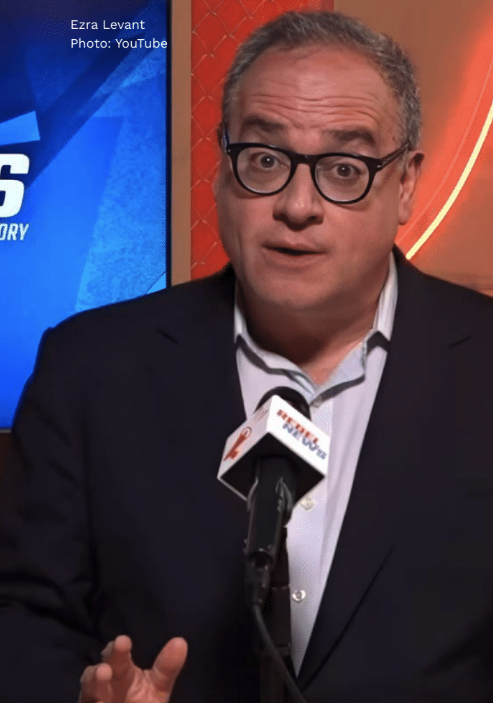
The numbers show just how vital this international connection is for his brand’s survival. Roughly 9% of all global views and interactions in this network come directly from Levant’s platforms alone. This means nearly one in every ten digital “touches” sustaining Lennon’s profile is shored up by his international sponsors. This setup provides him with a level of professional production and financial backing that makes it much harder to deplatform him or limit his reach within the UK.
One of the most significant and worrying examples of this international interference and sponsorship comes from the way Elon Musk supercharges the language he uses to support Lennon’s messaging and stoke division from afar. Our sentiment analysis of Musk’s X posts over the last six months shows that when Musk is talking about the UK, he is five times more likely to use high-conflict language than when he is discussing any other subject, e.g. “Civil War in the UK is inevitable.”
5. HIS DIVIDED ECHO-CHAMBER
The online conversation surrounding Lennon is almost entirely split into two warring camps, with virtually no middle ground. For every post that supports him, there is another attacking him, creating a digital space defined by “shouty” tribes rather than any real debate. The data shows a near-identical volume of posts on both sides, roughly 40% in favour and 35% against, leaving only a tiny fraction (25%) of people who aren’t firmly entrenched in one of the two extremes.
This creates a Lennon echo chamber where neutral or constructive discussion has effectively vanished. Lennon acts as a wedge, forcing the public into two distinct, opposing groups that refuse to talk to one another. Lennon’s digital landscape has become a permanent standoff where both sides simply amplify their own views, further deepening the social divide.
6. SPECTACLE OVER SUBSTANCE
Despite his profile, Lennon operates more like a media mogul than a political leader. Our analysis of more than 1,000 of his posts shows that less than 10% actually call for any specific policy change or tangible political action. Instead, the focus is almost entirely on the “spectacle” of his own life. He spends far more time, about a quarter of all his output, portraying himself as a martyr, turning his court dates and rallies into dramatic events designed to build his personal brand.
Ultimately, the product he is selling is his own struggle rather than a political solution. The drama is the end- point, not a means to an end. By prioritising personal storytelling over actual mobilisation, he keeps his audience engaged with a constant stream of “high- stakes” conflict, ensuring he remains the central character in a narrative of “us versus them” without ever having to deliver concrete political results.
7. RIOTING TO KEEP OUR STREETS SAFE – INCREASE IN CONFRONTATIONAL RHETORIC
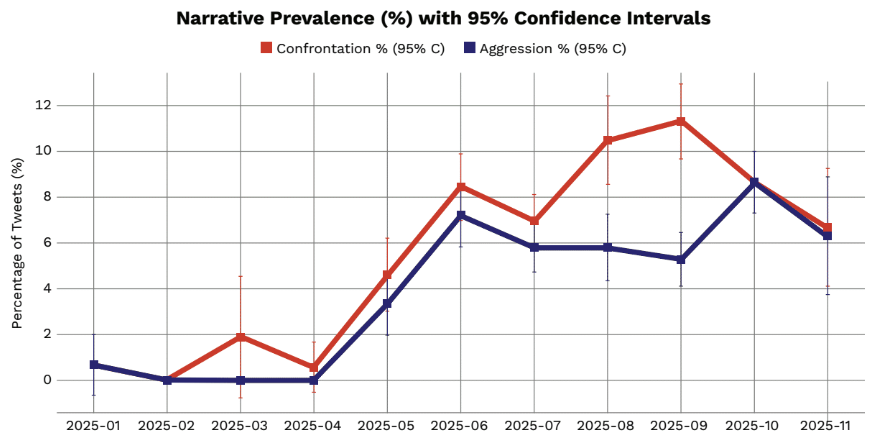
Analysis of over 9,000 posts and replies from 2025 shows a worrying shift in the way Lennon and his supporters talk online. They have always been aggressive in tone, but at the start of 2025, most posts and replies were aimed at bias or unfairness. However, by the autumn, the tone had darkened significantly.
References to “war,” “resistance,” and “civil unrest” surged from almost nothing to comprising more than 11% of all content. This spike in aggressive language was partly fuelled by international figures like Elon Musk, who helped inject his reckless “civil war” rhetoric into the British conversation.
This isn’t just a case of Lennon and supporters getting louder; it’s a shift in their core message. The UK far right has started using a “regime” narrative, where the UK government and mainstream media are no longer seen as just biased, but as illegitimate “traitors.” By framing the state as an enemy, they are creating a justification for more aggressive behaviour. This pivot is dangerous because it moves the conversation away from verbal insults and towards a mindset that sees physical social disruption as a defensive necessity.
8. 2024 VS. 2025: FROM PROTEST TO PROFESSIONAL
Between 2024 and 2025, Lennon’s digital profile underwent a massive transformation, moving from a reactive protest movement to a hate-charged media operation. In 2024, his supporters were mostly reacting to external news, such as the policing of the summer riots.
By 2025, however, the focus shifted inward to Lennon himself. His court cases and documentaries now account for nearly 30% of the discussion. The movement has essentially stopped being about “the news” and has become entirely about “Tommy” as a personal brand.
While the sheer scale of the operation has exploded, with posts jumping by 370% and retweets hitting over 15 million, this growth isn’t actually “organic.” Instead of a broad wave of public support, the numbers are being propped up by a small, professionalised inner circle of high-profile influencers. Interestingly, the average engagement per Lennon post actually dropped. In 2024, each post got an average of 2,163 retweets; in 2025, this fell to 1,695, suggesting that while he and his supporters are more visible than ever, he is less successful at getting ordinary people to join the conversation. Lennon has built a powerful, closed-loop online ecosystem that keeps him centre stage, but it is increasingly disconnected from the day-to-day concerns of the general public.
The 28.8% figure represents a deliberate flooding of the zone with personal propaganda rather than a response to public demand. If the movement were still about broad public issues, you would expect engagement to scale with the volume of posts.
Instead, the average engagement type indicates that Lennon’s “inner circle” is pumping out massive amounts of content about him that fails to resonate with the wider public.
HOW WE CALCULATED THESE FINDINGS
Our Data Desk used a sample drawn from Lennon’s X platform (@TRobinsonNewEra) including links and signposts to other platforms using content analysis. This allows for a comparison between Lennon’s personal output and the wider network’s reaction and engagement levels.
The primary data set comprised 13,500 total digital items. This is broken down into two specific categories where different proportions of the sample were applied to different statistical tests.
1. The “core” content (the source):
Sample size: 1,200 original posts authored directly by Lennon (or his administrative team) over the analysis period (Jan 2025–Dec 2025).
2. The “network” content (the reach):
Sample size: 12,300 additional interactions, including retweets, mentions, replies, and quoted posts from the wider ecosystem.
The analysis combined keyword tracking and temporal mapping to measure the frequency and sentiment of different narrative themes and engagement across a 12-month dataset.
State of HATE 2026 is your essential guide to the far-right threat—and how we stop it. View the full report today.

We need your help to continue our vital research. Your support is a stand against hate and division. It empowers our research and intelligence teams to effectively monitor far-right groups, ensuring we’re prepared for the challenges they bring.