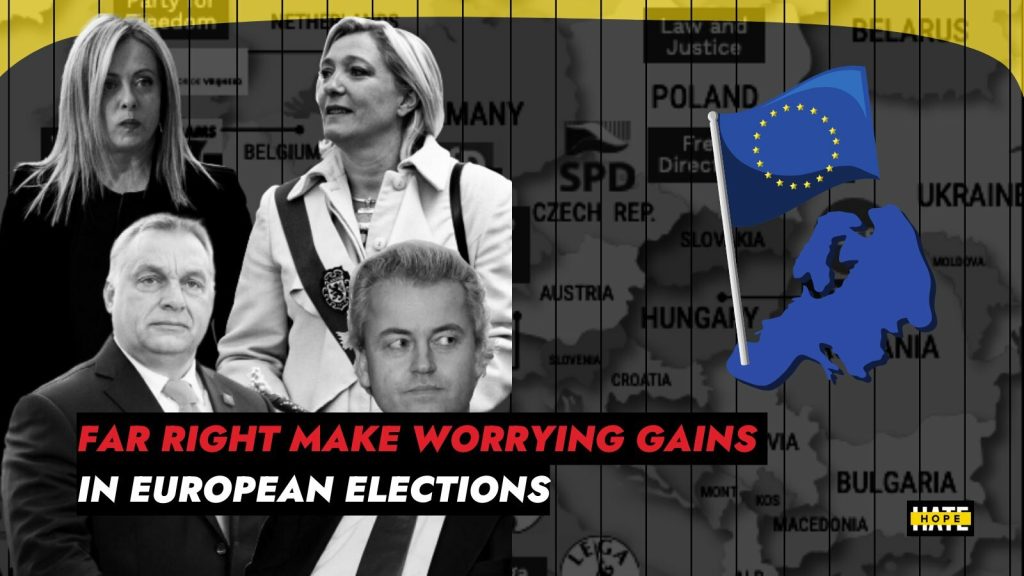
The performance of the far right in the European elections sadly comes as no surprise. In recent months the polls have been warning of far-right gains, and many of the results were in line with recent national elections. However, that doesn’t make them any less worrying. According to the British political scientist Simon Hix, this is “the most rightwing EP ever elected”.
The most significant result came in France where Marine Le Pen’s National Rally won nearly a third of the votes resulting in President Macron calling a snap national election.
In Italy, Giorgia Meloni’s Brothers of Italy (Fdl) topped the polls and doubled its seats in parliament beating out her far-right rival Matteo Salvini’s Lega party. Together, however, the Fdl-Lega vote combined isn’t dissimilar to the 2019 elections.
In Austria, the Freedom Party came first for the first time with 26% of the vote.
The Alternative for Germany party came second with strong showings in the regions that head to the polls later this year for state elections. This is despite a series of scandals, ranging from espionage to Nazi sympathies that have rocked the party in recent months.
In the Netherlands, Geert Wilders’ Freedom Party also came second with the New Flemish Alliance topping the polls.
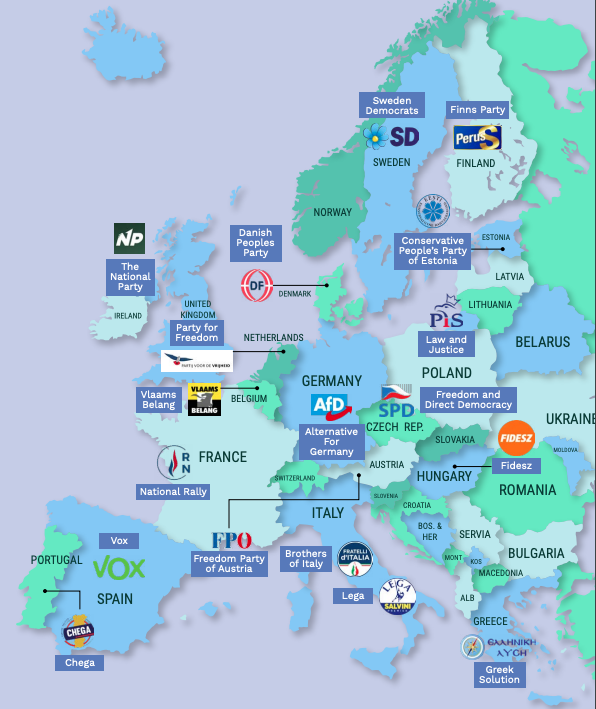
In Spain, the far-right Vox received 9.6% of votes, winning three new seats while a new radical right party, Se Acabó La Fiesta (The Party’s Over), secured its first MEPs with 4.6%. In Portugal, Chega came third with nearly 10% of the vote, picking up 2 seats.
In Cyprus it looks like the far-right ELAM has received a record high with 11.1% of the vote, winning one seat, while in Croatia the far-right Homeland Movement seem on course to win one MEP.
However, there were glimmers of hope. The Sweden Democrats’ vote decreased for the first time in its history, though not by enough to reduce their number of seats. The far right also lost ground in Denmark and Finland.
In Hungary, Viktor Orban’s Fidesz vote share declined significantly compared to 2019, though they still topped the polls.
In Poland the far-right Law and Justice Party came second with roughly 33% while another far-right party, Confederation, came third with nearly 12%, winning a seat for the first time.
Group Formation
There is no doubt that while uneven, the far right’s gains across Europe are of serious concern. However, a strong showing by the far right doesn’t necessarily mean more impact in the EP as European politics is all about group formation and at present there are huge divisions across the movement.
The EP elections are actually a collection of 27 national elections with the winning parties sitting together in groups defined by their ideology. The two furthest right of these are the European Conservative and Reformists (ECR) and the even further-right Identity and Democracy (ID).
While almost everyone accepts that ID is a far-right grouping, many in the media continue to call the ECR “conservative”. While there are a few Conservative parties still in the group, it also includes a raft of unquestionably far-right parties like the Sweden Democrats, Vox and Brothers of Italy.
The ECR now has 78 seats, an increase of 10, while the ID has 62, an increase of 3. However, the far right’s electoral gains are somewhat hidden by the number of parties currently undeclared.
Seventy-six seats are at present non-attached, many of which are newly elected members who are not yet allied to any group. Not all of these are far right, though some are, not least those won by the AfD which was recently thrown out of the Identity & Democracy group.
It could be some time before we know how the groups involving far right parties form and all eyes will be on the post-election wrangling over the coming weeks. One good sign is that significant divisions across Europe make it extremely unlikely that any single far-right group will emerge, thereby dividing their influence.
However, this is hardly a cause for celebration. An important point was made by Duncan McDonald, a leading expert of the far-right in the EU, who tweeted, “just a reminder that after EP 2014 election, the parties of Le Pen, Salvini, Wilders etc. were not even able to form a group for a year [be]cause they didn’t have enough countries.” Today, on the other hand, most far-right parties who win seats will go into well-established groups. “And that is a relative novelty if you think back just a decade,” adds McDonald.
Will the Centre Hold?
Reaction to the elections is still pouring in with much of the coverage understandably focusing on the far right.
All too often media coverage of the far right in elections slips into unhelpful binaries. Either the far right is said to be booming or collapsing. One unhelpful side effect of overstating the far right’s strength is that mainstream parties then seek to placate a distorted vision of what “the people” supposedly want, shifting the centre ground ever further right. It is worth remembering here the significance of turnout. Even in countries where the far-right have performed worryingly well, they still don’t speak for a majority in those countries.
Yet the answer to media sensationalism is not complacency. This isn’t normal. Or at least it shouldn’t be. The far-right performing slightly worse than feared in some countries doesn’t make the results any less shocking. We can’t allow relief to replace concern. That only contributes to the normalisation of the far right.
Another issue is knowing journalists and commentators rushing to describe strong far right results as predictable, as though that makes them any less dangerous. The best example of this last night was the BBC’s coverage describing Brothers of Italy doubling its number of seats as, “almost reassuringly predictable”.
So far, much of the coverage rightly explains how the centre is holding in the face of far-right gains. However, this is only significant if their politics hold as well.
One of the big questions that remains is whether, once groups have been settled, the centre right groupings, especially the European People’s Party (EPP), agree to work with the far-right.
In a recent interview with HOPE not hate, the political scientist Cas Mudde rightly explained that, “If you see authoritarian politics rising, the first one to blame isn’t the far right. The first one to blame is always the mainstream parties who have voted for it. Because in the end, without the mainstream, there is no majority for far-right politics.”
Last night Ursula von der Leyen, president of the European Commission, vowed to “build a bastion against extremes”, which is welcome, but this comes after she has spent a year courting the far-right Italian Prime Minister Giorgia Meloni. If the far right are going to be marginalised in Europe despite their electoral gains it will require the centre right refusing to engage with them and unfortunately, that seems unlikely.
Even though the far right remain a minority, they have reached a size where they have a dangerous impact on the wider politics of the continent, especially on issues such as immigration, gender and sexuality. One especially depressing outcome of these elections is that it looks like the majority for the European Green Deal has now gone.
We can’t just look at the size of the far right, we also have to understand the gravitational pull they have on wider discourse. Make no mistake, this was a good set of elections for the European far right.
Prefer to listen? Click the play button to hear the audio version. Harry Shukman Reform UK is staffed by oddballs and enigmas, but none odder…