
By ALEX MACKINNON
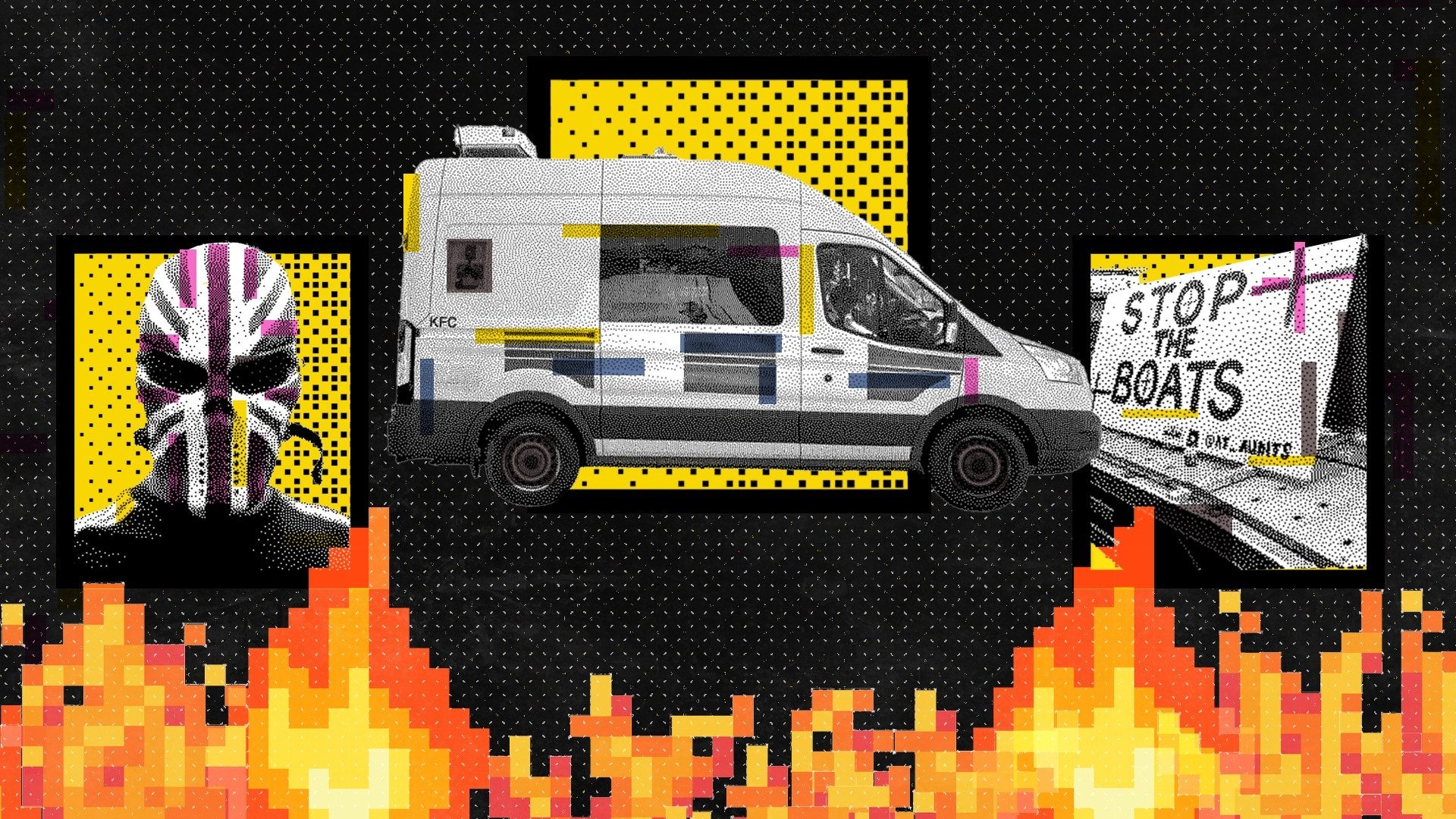
JUST SHY OF 100 people are gathered outside a run- down hotel in a sleepy English town. Most hold Union flags, some display Britain First or UKIP memorabilia, and others wear hoodies emblazoned with their local “patriots” logo. They chant “stop the boats” and “save our kids”. At least one man squares up to a policeman, accusing them of “two-tier policing”, and there are around five people sporting wearable cameras. The footage will be posted online later with an inflammatory title.
In the crowd, there are local women and children – but also an ex-EDL bodyguard, and a handful of Homeland Party or Patriotic Alternative members. They know this local anger is fertile ground for recruitment. When a resident quietly leaves the hotel, the crowd surges forward: “Where are you from?”, “Did you come here on a boat?”.
The summer of 2025 saw a wave of anti-migrant protests spread across the United Kingdom. In total, HOPE not hate tracked at least 251 events across 77 locations between June and December, with London, Epping, Norwich, Altrincham and the south coast being hotspots. Protesters mobilised around the use of hotels as accommodation for asylum seekers; subsequently, these hotels became the landscape for a summer of political discourse.
While some protesters were hardened far-right activists with histories of violence, others were local people with no formal connection to the broader movement, and many were somewhere in between. Some events featured women and children holding placards, others escalated into masked men hurling fireworks at police and attempting to break into hotels to attack residents.
However, attendees all gathered under the banner of “Stop the Boats”, invoking arguments around women and children’s safety and economic disparity to promote an anti-migrant position.
EPPING AND BEYOND
This phase of protests began in Epping, Essex across 7-8 July, after a woman and a teenage girl were sexually assaulted by an asylum seeker. Local far-right actors, including prominent ex-BNP activists, targeted Epping’s Bell Hotel. The location has been used to house asylum seekers since 2020, but the assault reignited these pre-existing tensions.
On Sunday 13 July, a local protest ended with two hotel security guards being physically assaulted, in what was later determined to be a racially aggravated attack. On Thursday 17 July, local anger descended into clashes, as protesters hurled fireworks and eggs at the police. Others ripped wing mirrors off police vans and attempted to break through the van doors, as onlookers shouted “smash it”. Protests in Epping continued throughout the summer, into the autumn and eventually the new year of 2026.
As Epping residents voiced understandable anger at the assault of local women, far-right actors took the opportunity to exploit such concern to spread their ideology. Callum Barker, then a member of the fascist Homeland Party who has been photographed posing with the Unabomber manifesto, became a leading activist in the area. The neo-Nazi group White Vanguard distributed leaflets, taking advantage of local concerns for their own ends.
As is typical, many attendees were not active members of far-right groups, but were taken in by the promise of safety and justice through mass deportations;
locals made vulnerable by the trauma of sexual violence in the community became fertile ground for radicalisation.
From this local case, a broader movement snowballed as other communities, encouraged by far-right influencers, formed protests outside so-called “migrant hotels”. Protests emerged in London around the Thistle Hotel at the Barbican and the Britannia Hotel in Canary Wharf, which saw masked men attack police. Protests were held outside the Park Hotel in Diss, where activist James Harvey was charged with a racially aggravated public order offence after referring to residents as “foreign filth”.
Nearby, ex-EDL member Glen Saffer led protests outside Norwich’s Brook Hotel. The Cresta Court Hotel in Altrincham was another flashpoint, as well as on the south coast where people in Portsmouth, Southampton and Bournemouth all founded their own respective anti-migrant groups. Other locations included Cheshunt, Falkirk, Braintree, Wakefield and Dublin.
RACISM AND VIOLENCE
Despite calls for peaceful protests across the UK, many locations saw aggressive levels of racism and violence. At a protest in Altrincham on the 27 July, Ryan Ferguson declared that “National Action is reforming”, chanting: “National Action and proud! National Action and proud!” National Action is a proscribed neo-Nazi terrorist organisation, and Ferguson was arrested under the Terrorism Act a few days later. At several other events, former National Front member Mike Gott was spotted clad in a British Movement flag; BM is one of the longest-running neo- Nazi groups in Britain.
On Halloween, fireworks were aimed at a hotel housing asylum seekers; one protester encouraged others to “get one through the window”, while others chanted “jump” when residents came to their windows. During an event in Portsmouth, one protester performed a Nazi salute – though the hosts, the Portsmouth Patriots, did immediately condemn the individual and ban him from future events.
Protests in Scotland saw particularly racist rhetoric; in Falkirk on 7 September, a protester held a sign reading “We must secure the existence of our people and a future for white children”. This is also known as the “14 words”, a notorious white-supremacist slogan. Also in Falkirk, a protester held a banner reading “Kill ‘em all, let God sort ‘em out”, and protest speeches included quotes like “Keep Scotland white”.
Violence also took hold of parts of Northern Ireland. When two teenage boys were charged with the sexual assault of a 13-year-old girl in Ballymena, a peaceful vigil descended into chaos. After reports that the perpetrators required Romanian translators, rioters threw petrol bombs, fireworks and bricks at the houses of people they believed to be migrants. In a single evening, they set four houses alight. Some local households resorted to placing signs in their windows indicating the nationality of the residents (e.g. “British Household” or “Filipino Lives Here”) in an attempt to prevent attacks.
After the sexual assault of a 10-year-old girl in Dublin in October, additional riots broke out. Over two evenings of violence, protesters armed themselves with garden forks and tools, throwing fireworks at the police. Some arrived on horseback and attempted to charge police lines, others dislodged tarmac to use as projectiles at police. Eyewitnesses described children as young as seven throwing bricks.
FLAGS, FRANCE AND VIGILANTES
While the racism and violence of some protests hit the headlines, the anti-migrant movement was becoming a multi-faceted front. The summer saw mass flagging operations, a rise in vigilante groups and a flurry of French beach visits that extended into the winter. Activists did not restrict themselves to simple protesting, and those willing to mobilise more broadly soon took to more direct action.
Operation Raise the Colours is a nationwide flagging campaign originally started by ex-EDL member Andrew Currien, better known as Andy Saxon. It encouraged individuals to fly the St George’s Cross and Union flags, both within their homes and in public spaces such as off lampposts and bridges; some went the extra mile and began painting roundabouts and zebra crossings with the St George’s cross.
As some insisted that the movement was about creating unity and pride in the flag, others saw it as an opportunity to “mark their territory” in areas with higher non-white populations. A cat-and-mouse game began, between activists hanging flags and others taking them down; when the two parties collided, tensions were high and often resulted in aggressive confrontations.
While certainly not all those hanging flags could be considered “far right”, the movement attracted extremist interest. Britain First funded flags across the Midlands, attending outings in Manchester and surrounding areas to hang them. The Nottingham flagging group was headed by Guramit Singh, a close associate of Stephen Lennon. In many areas, football hooligans gathered supporters to distribute flags in their areas and in Salford, a flagging campaign was led by Lee Twamley, a convicted human trafficker.
In the small Kent town of Faversham, a flagging group led by activist Harry Hilden attracted attention after several altercations with residents. One member of the group was filmed threatening to headbutt a man who attempted to remove a flag from outside his home.Hilden organised “watch duties” to prevent flags from being removed – a trend which caught on amongst other groups who were willing to challenge anyone trying to take down flags.
In some areas, flagging campaigns descended into racist abuse. A Chinese takeaway in York was covered in racist graffiti and St George’s flags; an NHS worker in Halifax was racially abused; a man hanging a flag on a building in Basildon shouted Islamophobic abuse at a passing woman and her child; and a local mosque was spray-painted with St George’s crosses.
VIGILANTE ACTION
In parallel to these individual acts of intimidation and abuse, some resorted to more organised and confrontational forms of action. Where community- safety narratives combined with a growing mistrust of police and “two-tier justice”, vigilantism became a popular form of far-right activism. Vigilante groups have been a longstanding part of the far-right, with Britain First partaking in “Christian Patrols” in areas with high populations of Muslims as far back as 2014.
This year, various “patrol teams” sprung up across the country. Some took formal, uniformed approaches while others proved more dangerous and confrontational; some remained focused on local community action, while others set their sights on French beaches to “stop the boats” themselves.
In Northern Ireland, the East Belfast Nightwatch First Division harassed black and brown men in the area; their social media showed them threatening and verbally abusing people. Their small team boasted a history of convictions for animal abuse, attempted murder, possession of an offensive deadly weapon and lying in court. Bournemouth’s Safeguard force was not as extreme as the Belfast team, but its leader Gary Bartlett hosted a racist Facebook page and welcomed an ex-EDL member into the group.
Other groups engaged in vigilante activism across the English Channel. UKIP partnered with members of Patriots of Britain to host trips to Calais. They marched through migrant camps with large banners, shouting at asylum seekers and charity workers while holding enormous poles featuring the Union flag and the St George’s cross.
LOOKING FORWARD
After a year of protests which seem likely to roll into the spring of this year, anti-migrant rhetoric has become an increasingly noisy issue. Genuine local concern for community safety, and upset following sexual assault cases laid fertile ground for far-right narratives to take hold amongst more mainstream audiences. Violence from aggressive protesters and racist narratives spread by seasoned far-right activists invoked fear in local communities. The protesters scapegoated immigrants and asylum seekers as the sole reason for real financial struggles, encouraging racist hate as the solution to hardship. Few of the far-right activists leading anti-migrant protests and spouting bigotry offered genuine solutions for everyday people – instead, they encouraged division, mistrust and violence.
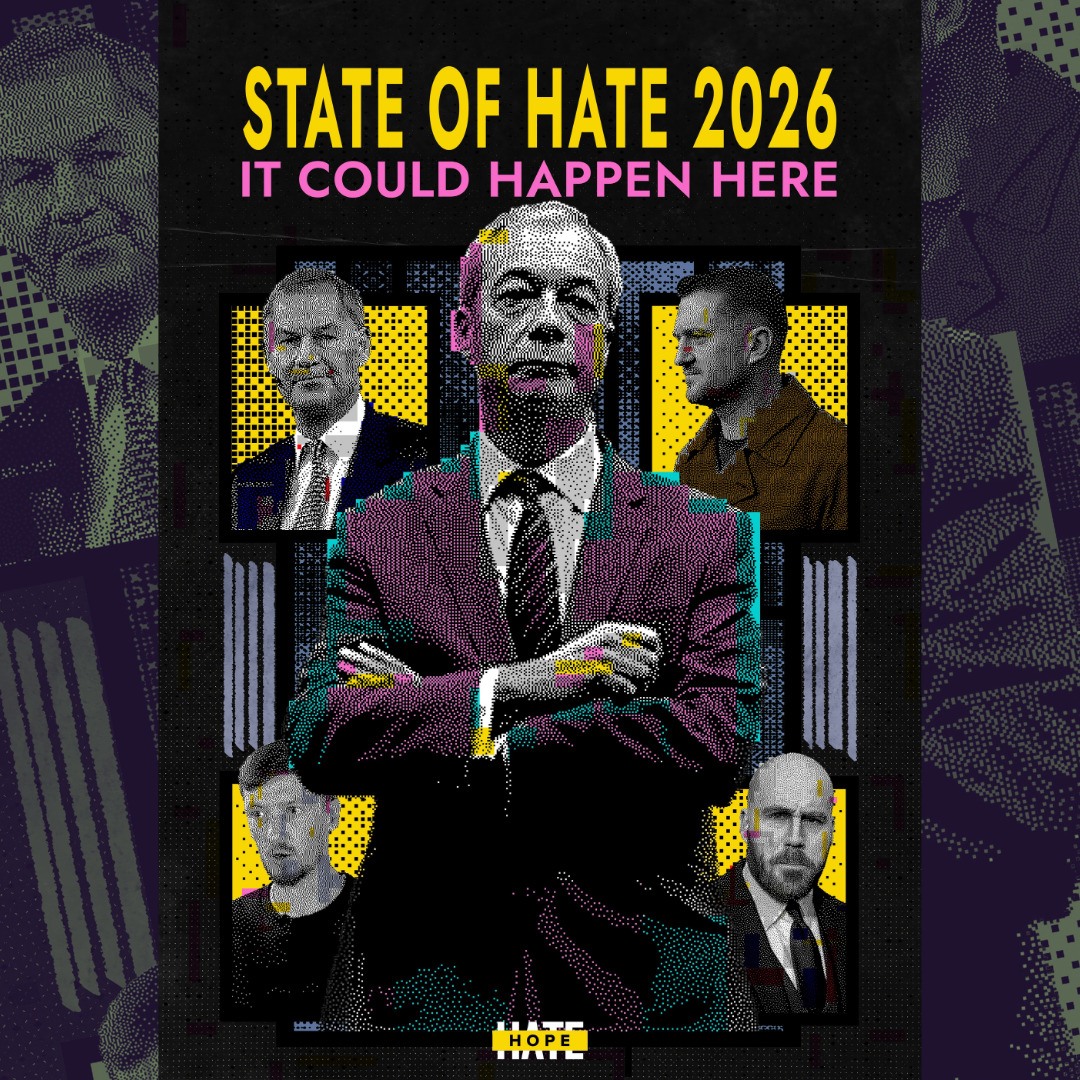
State of HATE 2026 is your essential guide to the far-right threat—and how we stop it. View the full report today.

We need your help to continue our vital research. Your support is a stand against hate and division. It empowers our research and intelligence teams to effectively monitor far-right groups, ensuring we’re prepared for the challenges they bring.