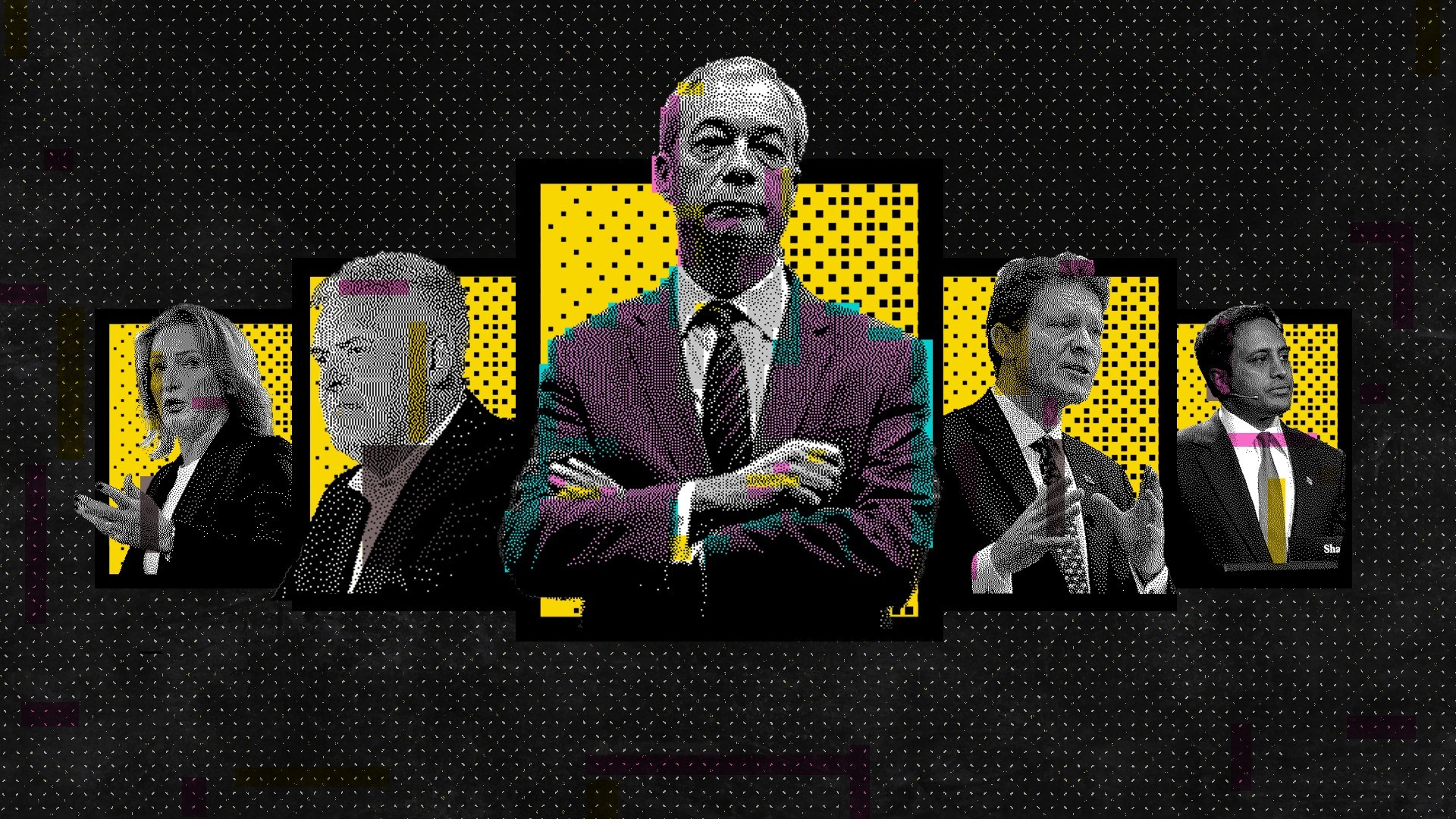
Reform UK’s senior leadership includes long-standing radical-right figures, former Conservative ministers who have shifted further right, and politicians associated with conspiracy rhetoric and inflammatory statements.
Behind the anti-establishment branding, Reform’s leadership shows a mix of ideological extremity, media-driven politics and limited governing track record.

Nigel Farage has had a long career in radical-right politics. He was first elected to the European parliament for UKIP in 1999 and served as an MEP until 2020, when the Brexit deal was approved. Having led UKIP from 2006 to 2009 and again from 2010 to 2016, from April 2019 (to March 2021) Farage led the Brexit Party, which was renamed Reform UK in January 2021. In the past, Farage’s influence on Westminster politics has been from the outside, with his parties acting as pressure groups for Eurosceptic causes.
By early 2024, it seemed Farage would never achieve a seat in Parliament, for which he had unsuccessfully stood seven times. In February that year, he gave an interview to The Times in which he said:
“Do I want to be an MP? Do I want to spend every Friday for the next five years in Clacton?” The reporter explained: “His expression suggests not.”
On 3 June 2024, however, Farage announced that he would be taking over from Richard Tice as Reform’s leader and duly stood for Clacton in the July general election, where he won with 46.2% of the vote.
Since becoming an MP, Farage’s record has been a poor one. As well as missing numerous key votes, in his first year as an MP he spoke fewer times in the House of Commons than any other party leader. Farage has, however, been more diligent in his work outside Parliament. From July 2024 to the end of 2025, he earned more than £1.5 million for numerous “second jobs”, including over £626,000 for presenting on GB News, £415,500 for acting as a brand ambassador to a gold bullion firm, and £180,000 for making video messages on Cameo.
Farage hasn’t always transparently declared his financial interests as required by parliamentary rules. In January 2026, the Parliamentary Commissioner for Standards found Farage had breached the rules 17 times by not declaring financial interests within the 28-day time limit. Farage said he had been “extremely let down by a very senior member of staff”, adding that he doesn’t “do computers” as he isn’t “computer literate”.
Throughout his life, Farage has had a track record of racism and xenophobia. Building on the work of journalist Michael Crick, in November 2025 the Guardian published an investigation into Farage’s racism and antisemitism while a student at Dulwich College private school, which included the testimony of more than 20 former schoolmates. One contemporary, Peter Ettedgui, recalled Farage saying “Hitler was right” and “Gas them”, while another said he taught younger pupils “the infamous ‘Gas ‘em All’ song, or at least led the singing of it”. Despite the number of people who had accused him, Farage described the allegations as “complete made-upfantasies”.
Farage has long admired Enoch Powell, infamous for his racist “Rivers of Blood” speech in 1968. In 2011, he called Powell “a singularly great man” and in 2008 commented:
“I would never say that Powell was racist in any way at all. Had we listened to him, we would have much better race relations now than we have got.”
Speaking on LBC in 2014, Farage suggested people in London would be concerned if Romanian men moved in next door, comments he later rowed back. In 2017, he expressed concerns about the so-called US “Jewish lobby” and described Jewish philanthropist George Soros, a regular target of conspiratorial antisemitism, as “the biggest danger to the entire western world”. Muslims have also been a target of Farage. During a Sky News interview in May 2024, he claimed there is “a growing number of young people in this country who do not subscribe to British values, in fact loathe much of what we stand for”, adding that he was talking about Muslims.
On top of all that, Farage has indulged conspiracy theorists over climate change and COVID vaccines. In 2009, he referred to the “very, very questionable concept of global warming caused by CO2 emissions”, while in January 2026 he told Times Radio:
“I believe in vaccinations when they’re vaccinations. I don’t think what happened with COVID were vaccinations.”

A multi-millionaire property tycoon, Richard Tice first rose to public prominence during the Brexit referendum. In 2015, he co-founded Leave.EU, the unofficial pro-Brexit campaign, which he co-chaired with Arron Banks. As well as relentlessly exploiting fears around immigration in the build-up to the referendum (as epitomised by the notorious “Breaking Point” poster), Leave.EU paid for adverts targeting supporters of extreme-right groups and failed to declare more than £77,000 inexpenditure, resulting in a fine from the Electoral Commission.
After the 2016 referendum, Tice co-founded Leave Means Leave, a pressure group for a hard Brexit. In 2019, he became chairman of the Brexit Party (Reform UK’s previous incarnation) and served as one of the party’s MEPs from July 2019 to January 2020, when the Brexit deal was approved. Following Farage’s resignation as leader of the recently renamed Reform UK in March 2021, Tice took over at the helm. He served as the party’s leader until June 2024, when Farage decided to re-enter the political fray, and became Reform’s deputy leader the following month, when he was elected as MP for Boston and Skegness with 38.4% of the vote.
Tice has been outspoken on COVID vaccines and green initiatives. In February 2024, he committed Reform to a public inquiry regarding “excess deaths” and “vaccine harms” (a position endorsed by Farage) and, in March the same year, he said:
“We are not in [a] climate emergency; nor is there a climate crisis.”
It’s rather awkward, then, that Tice’s businesses have had a long track record of supporting sustainability and green initiatives.
Tice’s business interests also came under scrutiny in 2019, when openDemocracy revealed that two offshore firms, based in Panama and the British Virgin Islands (both notorious tax-havens), controlled 42% of his family business, Sunley Family Limited. Tice said he didn’t know who was behind these companies and that he is a UK taxpayer. In 2024, a joint investigation by the Good Law Project and the Mirror found Tice had previously transferred shares in a commercial property company into a family trust, based in another tax haven, Jersey (although it was later relocated to the UK).
Lee Anderson’s political career has been a tumultuous one. In 2015, he was elected as a Labour councillor in Ashfield, but, in February 2018, he was suspended by the Labour group on the council after receiving a community protection warning for placing boulders to deter members of the Traveller community from “setting up camp”. The following month he defected to the Conservatives.
In the 2019 general election, Anderson was elected as Tory MP for Ashfield and became the subject of several controversies, including revelations he had made sexist comments. The final straw came in February 2024, when he had the Conservative whip suspended after refusing to apologise for voicing an anti-Muslim conspiracy theory on GB News, where he said: “I don’t actually believe that the Islamists have got control of our country, but what I do believe is they’ve got control of Khan and they’ve got control of London, and they’ve got control of Starmer as well.”
While this was too much for the Conservatives, Anderson was welcomed with open arms by Reform. In March 2024, he defected to the party, becoming its first MP and was re-elected in the July 2024 general election with 42.8% of the vote, subsequently being made the party’s chief whip. In November the same year, Anderson had to apologise, after an investigation by parliament’s bullying and harassment watchdog found he had told a security guard to “f*ck off, everyone opens the door to me,” when asked to show his parliamentary pass.
Alongside his job as an MP, Anderson also earns £100,000 a year for presenting a GB News show every Friday, despite having previously spoken out against MPs having second jobs.
“We are paid handsomely for the job we do and if you need an extra £100,000 a year on top then you should really be looking for another job,” he wrote on Facebook in 2021.
Sarah Pochin became a Reform MP in May 2025, when she won the Runcorn and Helsby by-election for the party by just six votes. She’s certainly made her mark since. At PMQs on 4 June 2025, she asked Keir Starmer whether he will “ban the burqa” in “the interests of public safety”, something which prompted a public row in the party (see subsequent section on Zia Yusuf). In October, she received widespread condemnation after saying on TalkTV:
“It drives me mad when I see adverts full of black people, full of Asian people”.
Pochin, who subsequently said her comments were “phrased poorly”, kept the party whip.
Danny Kruger became the first MP to defect from the Tories to Reform after the 2024 general election, joining Farage’s party in September 2025. Kruger’s defection, the month after Reform announced its extreme mass deportations policy, marked yet another step on his long journey to the right.
Kruger had been involved in Conservative party politics for over two decades and served as David Cameron’s speechwriter from 2006 to 2008. During this period, he penned Cameron’s infamous “hug a hoodie” speech, which was widely interpreted as a liberal shift in Tory politics, and, in 2013, he criticised the Cameron government for moving away from these aims, saying:
“I’d like to know where David Cameron’s
compassionate Conservatism has gone. I would regret an election campaign that focused on skivers and sending immigrants home.”
In 2019, Kruger served as Boris Johnson’s political secretary, before being elected as the Conservative MP for Devizes in the general election that December. A sign of how Kruger’s views had changed came when he spoke at the National Conservatism Conference in May 2023, where he criticised New Labour for “opening the floodgates on immigration” and claimed that marriage between men and women “is the only possible basis for a safe and successful society” – a position from which then-PM Rishi Sunak distanced himself. The following month, Kruger defended the use of the phrase “cultural Marxism”, despite its association with antisemitic conspiracy theories.
Robert Jenrick, the erstwhile shadow justice secretary whose failed bid to become Tory leader in 2024 was run by Kruger, became the second Tory MP to switch allegiance to Reform when he defected on 15 January. Jenrick, who was called “a fraud” by Farage in August 2025, had been in discussion with figures in Reform since September, around the time Kemi Badenoch’s ratings started to improve, making his prospects of taking her position seem increasingly remote.
While his defection became a matter of great political drama (after he was sacked as shadow justice secretary and lost the Tory whip inthe morning, when Badenoch was handed “irrefutable evidence” of his intentions), it underlined how happy Reform is to welcome ex-Tories no matter how bad their previous record.
Jenrick first became an MP in 2014, when he won the Newark by-election for the Conservatives, and went on to serve in a number of ministerial posts, including housing secretary from 2019 to 2021. He showed his true colours on 14 January 2020 when, against the recommendation of a planning inspector, he hastily approved a £1 billion luxury housing development in east London. The development was backed by Conservative donor Richard Desmond, with whom Jenrick had corresponded after sitting next to him at a party fundraising dinner – the timing of Jenrick’s decision, the day before the introduction of new infrastructure charges, meant Desmond’s company saved up to £50 million. Jenrick later accepted his decision was “unlawful”.
In October 2022, Jenrick became immigration minister in Rishi Sunak’s government, and it was from this period that his beliefs moved towards the extreme.
In July 2023, for instance, he drew widespread condemnation after ordering murals – depicting characters like Mickey Mouse – be removed at an asylum centre for unaccompanied children in Kent, reportedly because he thought them too welcoming. In December that year, Jenrick resigned from the government, on the grounds that legislation to send asylum seekers to Rwanda did “not go far enough”.
Following the 2024 general election and his failed bid to become Tory leader, he became shadow justice secretary. In September 2025, he called for a “decade of net emigration” and said the Conservatives ought to go even further than Reform’s extreme mass deportations policy. The following month, the Guardian revealed Jenrick had made false and inflammatory comments at a local Conservative Association dinner in March, where he said:
“I went to Handsworth in Birmingham the other day… I didn’t see another white face and that’s not the kind of country I want to live in.”
After his defection, The Sunday Times obtained a leaked media plan drawn up by his office, in which Jenrick was described as “the new sheriff in town”. Both Jenrick and Farage rivalling for the spotlight could be a catalyst for future tensions in the party.
Just days after Jenrick’s defection, another Tory MP and shadow minister, Andrew Rosindell, jumped ship to Reform. To rather less fanfare, Rosindell announced his decision in a social-media post on the evening of Sunday 18 January.
Despite having been Romford’s MP since 2001, Rosindell has kept a relatively low profile and never held ministerial office, although has burst into the public consciousness on a few occasions. During the 2009 MPs’ expenses scandal the Telegraph reported that he had claimed over £125,000 in expenses for a second home in London, while designating his childhood home, located 17 miles away and where his mother was living, as his principal address. Since then, he has been found in breach of parliamentary rules for failing to declare relevant interests when submitting questions to ministers, has expressed “huge admiration” for Chilean dictator Augusto Pinochet, has opposed gay marriage, and has been a member of a Facebook group for Tommy Robinson supporters.
From May 2022 to February 2024, Rosindell did not attend Parliament, after being arrested on suspicion of sexual offences and misconduct in public office. Rosindell denied any wrongdoing, was not charged, and the Met Police told Rosindell in February 2024 that he faced no further action.
The final Tory MP to defect to Reform in January was Suella Braverman, formerly home secretary under both Liz Truss and Rishi Sunak, who said she felt like she had “come home”. Braverman’s husband, Rael, had previously been a Reform member, but quit the party in July 2025. This came after Zia Yusuf had appeared to blame Suella Braverman and Robert Jenrick for the Conservative government having granted asylum to Afghans put at risk by a Ministry of Defence data leak. Braverman’s husband rejoined the party when she defected.
Braverman was first elected to Parliament in 2015 and soon secured her position in the right of the Conservative party, becoming chair of the Eurosceptic European Research Group caucus in 2017. She first became a cabinet minister under Boris Johnson, when she was appointed attorney general in February 2020.
Over the course of her political career, Braverman has proffered a number of controversial views. In 2019, for instance, she said “we are engaged in a battle against cultural Marxism”, a phrase associated with conspiratorial antisemitism; in 2022, she referred to an “invasion” of migrants; in 2023, she declared that “we will not be able to sustain an asylum system if in effect, simply being gay, or a woman, and fearful of discrimination in your country of origin is sufficient to qualify for protection”; and in 2025, she wrote for the Telegraph that English identity “must be rooted in ancestry, heritage, and, yes, ethnicity”.
After the July 2024 general election, Zia Yusuf became Reform’s chairman, a position in which he served until 5 June 2025 when he posted on X:
“I no longer believe working to get a Reform government elected is a good use of my time, and hereby resign the office.”
This came after Yusuf said it was “dumb” for Reform MP Sarah Pochin to call for a burqa ban at PMQs that day.
Just two days later, Yusuf decided to return to Reform, telling The Sunday Times that his decision to quit was a “mistake”, that on reflection if there was a parliamentary vote on banning the burqa he would “probably” vote in favour, and that he would now lead Reform’s Elon Musk-inspired Department of Government Efficiency. Yusuf changed roles again in September, taking over from conspiracy-theorist Simon Marcus as the party’s head of policy.
Initially, it did not seem Yusuf was entirely happy with Reform’s decision to welcome Robert Jenrick, who had previously called for him to be booted out of the party, on 15 January. He did not attend the press conference, did not post anything on social media supporting Jenrick, and instead simply trumpeted that no more Tories will be able to join Reform after 7 May. On 18 January, however, he told Sky News that Jenrick’s defection was an “important milestone”.
Prior to entering politics, Yusuf worked at Goldman Sachs, before in 2014 co-founding Velocity Black, a concierge company, which was sold in 2023 for over £200 million. In June 2025, the BBC reported that, according to former employees, Yusuf was difficult to work with, sometimes showed a lack of regard for those around him, and lacked leadership skills during his time at Velocity Black. Some of Yusuf’s largesse from his previous career has been pumped into Reform. In 2024, he donated over £200,000 to the party.
Following Yusuf’s dramatic resignation as Reform’s chairman in June 2025, television presenter David Bull – who called Farage an “idiot” in 2014 for “ill- judged, prejudiced and dangerous” comments that HIV-positive immigrants shouldn’t be allowed to receive NHS treatment – was appointed to the role.
At Reform’s conference in September 2025, Bull introduced the controversial doctor Aseem Malhotra to the stage as someone who “worked with me to write Reform UK’s health policy”, before Malhotra indulged in pseudoscience, suggesting COVID vaccines may have caused cancer in the royal family.
Bull joined the Brexit Party (Reform’s previous incarnation) in 2019 and briefly served as one of its MEPs. He subsequently served alongside Ben Habib as one of Reform’s deputy leaders from March 2021, but departed from this role after the July 2024 general election, in which he failed to win a seat, coming third in the West Suffolk constituency.
Aside from his involvement in politics, Bull has had a long career as a television presenter, working on Newsround, Watchdog, and Most Haunted Live. Presenting the latter made him believe in ghosts, due to having “very odd experiences in the paranormal” while working on it.
Having worked in private equity and donated almost £150,000 to the Conservatives, Malcolm Offord was conferred a peerage during Boris Johnson’s premiership, becoming Baron Offord of Garvel in October 2021. Upon his appointment to the House of Lords, Offord was given a ministerial job in the Scotland Office and he additionally became a minister in the Department for Business and Trade in April 2023, under Rishi Sunak.
After the Tories were ousted in the 2024 general election, Offord became the party’s shadow energy minister, but in December 2025 he defected to Reform and announced that he would resign from the House of Lords in order to stand for Farage’s party in the Holyrood election. The following month, Reform named Offord as its Scottish leader.
Luke Campbell is a former professional boxer who won gold in the bantamweight category at the 2012 London Olympics. After retiring from boxing in 2021, he was announced as Reform’s candidate for Hull and East Yorkshire mayor in February 2025. Hoping to echo Donald Trump’s success in the US, Campbell won the mayoral election in May, with 35.8% of the vote.
By August, there were reports that Campbell was “at war” with staff in the combined authority, with insiders claiming he had created a toxic environment. Campbell also faced criticism for failing to turn up for a lunch prepared for him by catering students with special educational needs in October. A witness told The i Paper that Campbell arrived on time but “yawned through the morning’s meetings, said it wasn’t for him and left before lunch”. A spokesperson for Campbell claimed he was “pulled away by Combined Authority officers” over an “urgent matter”.
Andrea Jenkyns was first elected as Conservative MP for Morley and Outwood in the 2015 general election. Having supported Brexit and been vice chair of the party’s Eurosceptic European Research Group, she first achieved ministerial office during Boris Johnson’s government, becoming a government whip in September 2021 and junior education minister in July 2022.
Jenkyns lost her seat in the 2024 general election and defected to Reform in November 2024, announcing that she would stand as the party’s candidate to be mayor of Greater Lincolnshire in May 2025, an election she won with 42% of the vote. Upon her election, Jenkyns immediately provoked condemnation after saying that asylum seekers should be housed “in tents”.
Like many in Reform’s ranks, Jenkyns is a conspiracy theorist. In October 2024, she claimed (falsely) that the World Health Organisation “was trying to bring in globally this legislation which they could enforce lockdowns on countries” and said, in July 2025, she doesn’t believe in climate change, adding that it is just a “money-making racket” for some industries.
Jenkyns is also a Liz Truss fan, telling a podcast in 2024: “Liz Truss, as well, I think she had the right policies, especially for business, but she didn’t have long enough to enact them unfortunately.”
After becoming the Reform leader of Kent County Council, Linden Kemkaran, formerly a journalist at the BBC and Spectator, told the Daily Telegraph’s podcast in June 2025 that Kent is
“the shop window now for Reform, through which the electorate are looking to judge whether they think they can put their trust in a Reform government at the next election to take the reins of power for the entire country”.
Such a confident pronouncement was perhaps not the wisest move. Since then, under Kemkaran’s leadership, Reform’s Kent team has been riven with internal division. This was already clear by September, when an undercover HOPE not hate reporter overheard Reform’s South East organiser Adam Wordsworth saying the party’s Kent councillors “are all wankers” who “hate” and “fight with each other”.
On 18 October, the Guardian published a leaked video of an online meeting between Reform’s Kent councillors, revealing bitter division and showing Kemkaran berating colleagues, telling them to “fucking suck it up” if they disagree with her decisions. In the aftermath of the leak, four councillors were immediately suspended, before being expelled from the party alongside others, and seven MPs called for Kemkaran to quit as she’s “clearly not up to the job”.
While Reform initially had 57 councillors in Kent after the May local elections, Kemkaran’s careful stewardship saw that number dwindle to 48 by the end of 2025.
When Andrew Husband became Reform’s Durham County Council leader in May, a party spokesperson commented that he “is a business leader with a proven track record of growth in start-ups and building successful teams”.
Shortly thereafter, Private Eye pointed out that Husband’s track record in business doesn’t actually look so good. The magazine reported that he had a string of short-lived directorships and owned a company called United Hygiene and Catering Equipment Ltd, which was in liquidation owing around £1 million to creditors, as well as another, UHC Leisure Ltd, owing around £472,000.
In January, The Sunday Times further highlighted Husband’s background, explaining that he
“is the owner of two companies which have been placed into administration owing £1.5 million, including more than £500,000 in tax, government-backed COVID loans, and staff pay.”
Husband has defended his business record, insisting “there is no suggestion I have done anything wrong”.
In May 2025, when Reform took control of Lincolnshire County Council in the local elections, Sean Matthews became the council’s leader. As well as being a retired police officer, Matthews is a conspiracy theorist.
On X, Matthews has claimed that Labour and the Conservatives “are controlled by WEF [World Economic Forum]”, shared posts referring to global warming as a “scam”, and promoted anti-Muslim conspiracy theories. One post shared by Matthews claimed David Cameron had a “sinister plot to hand UK leadership to Muslims”, before declaring that the “Islamic takeover is real and happening… every party’s in on it” while another suggested that Keir Starmer is “owned by Muslims”.
Among the decisions made by Lincolnshire County Council during Matthews’ time in charge has been to conduct a 12-month trial of JCB’s Pothole Pro machine, starting in September, despite the council having previously conducted a pilot and “found better tools for our county’s need”. In November, JCB announced it has donated £200,000 to Reform.
Mick Barton, who became the new leader of Nottinghamshire County Council after Reform took control of it in the May local elections, has been involved in local politics in the county since 2003. He used to be a miner, before becoming a car sales executive and then setting up his own business in 2000. In October, the Guardian reported that a carpet-fitting business belonging to Barton’s family had been threatened with compulsory strike off action from the company register due to late filing of accounts, which is technically a criminal offence.
Most notable about Barton’s leadership of the council thus far has been his dismissive attitude towards the media. In August, he banned Reform’s Nottinghamshire councillors from engaging with the Nottinghamshire Post, after it published a story about plans for the restructuring of local government. The local newspaper’s editor warned that Barton’s decision was a “massive attack on local democracy”. The ban was finally lifted in October, after both widespread condemnation and the threat of legal action.
State of HATE 2026 is your essential guide to the far-right threat—and how we stop it. View the full report today.

We need your help to continue our vital research. Your support is a stand against hate and division. It empowers our research and intelligence teams to effectively monitor far-right groups, ensuring we’re prepared for the challenges they bring.