
Misbah Malik
On 29th July 2024, news broke of a horrific attack at a dance workshop in Southport, Merseyside. Axel Rudakubana has since pleaded guilty to the murder of three young girls and attempted murder of ten others.
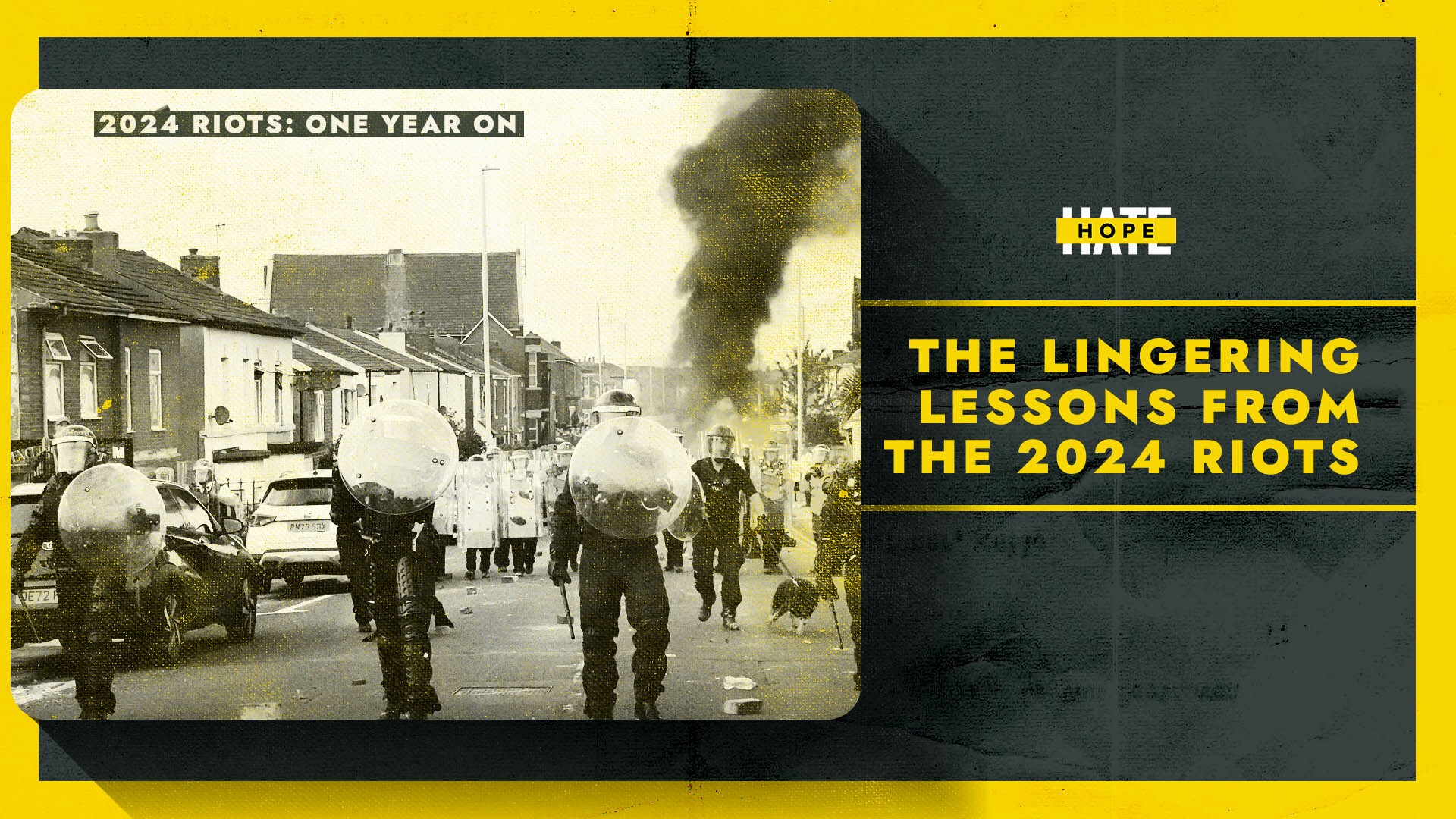
Whilst many came together to collectively mourn, others chose to respond by participating in the largest outbreak of far-right rioting and disorder in the post-war period.
A swift criminal justice response quickly put a stop to the physical violence but, one year on, the problems that spurred it are anything but fixed. The riots may have dropped off media circuits, but the wider issues they bore must remain on the political agenda. The riots exposed broader vulnerabilities to far-right agitation, giving us insight into how we can and should build community resilience to this sort of activity in the future.
HOPE not hate polling finds 75% of Britons want the Government to do more to address the underlying issues that gave rise to the violence, and over half (58%) think there is a threat of similar violence breaking out again. Notably, the same narratives that drove the violence last year also drove the recent anti-migrant disorder in Ballymena, Epping and Diss. Whilst more similar to the disorder seen in Knowsley in July 2023 than the 2024 riots – whereby Knowlsey acted as a flashpoint which spurred a tail of copycat protests as opposed to the rapid escalation of violence we saw last summer – these recent disturbances should be yet another warning of the dangers of inaction.
In the last year, the Government has set the bar high in ambition to deliver for communities, for example through the Plan for Neighbourhoods and the Devolution and Community Empowerment bill. These are great opportunities for addressing the root causes of low resilience in our communities, and it is crucial that the government follows through. Most importantly, all this work must be underpinned by a unified vision for British identity and a genuine commitment to power sharing.
A Disunited Kingdom: We need to rebuild an inclusive British identity
From the swathes of online mis- and disinformation about the identity of the Southport attacker emerged one clear narrative – “multiculturalism has failed”. Offline, we saw people smash mosque windows with bricks in the name of defending against the ‘threat’ of Muslims, migrants and multiculturalism.
Previously confined to the fringes of the far right, this narrative has become increasingly normalised, a result of deliberate vilification by the radical right ecosystem. Unsurprisingly, HOPE not hate polling shows that support for multiculturalism has dropped over the last few years, after stabilised improvements over the last decade. The far right were so successful at instigating violence during the riots because they were able to tap into this preexisting hostility, and exacerbate it.
Immediately post-riots we saw a spike in hatred towards Muslims, migrants and multiculturalism. Despite the physical violence fizzing out after a few weeks, attitudes remain hostile one year on.
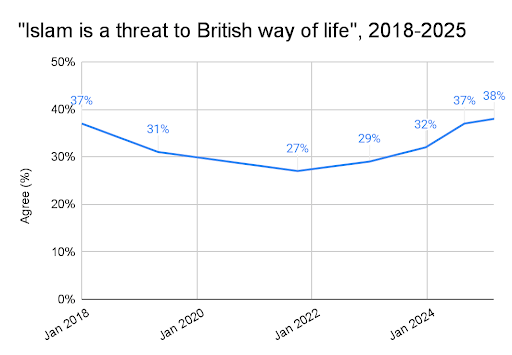
Half (51%) of Britons think multiculturalism ‘isn’t working’ and over a third (38%) think that Islam is a threat to British way of life, a number that has worryingly been on the rise since 2021.
This is notably impacting cohesion, as relationships remain volatile. 44% think relationships between white and ethnic minority groups have gotten worse over the last five years, and only 23% think they will get better over the next five years.
Despite these clear problems, we are yet to see a centralised cohesion strategy to directly address them. Relationships splintered by the riots must be rebuilt, whether that be through hate crime prevention, inter-group contact initiatives, community conflict resolution, education or youth engagement.
Crucially, there is an appetite for work to strengthen social connection within communities. Despite bleak perceptions of cohesion nationally, the story at the local level is far more optimistic. A large majority of Britons (73%) say they enjoy mixing with people of other religions, ethnicities and backgrounds, 63% think their local community is peaceful and friendly, and 41% want to get to know their neighbours better.
Requirements for local authorities to produce their own cohesion strategies could go a long way to ensure this work remains a priority. But ultimately, this all must be underpinned by a unified, inclusive vision for British identity and a strategy and guidance from central Government on how to pursue this.
This also requires investment. Funding for third sector organisations who pursue this work has sharply declined, and cohesion initiatives are often the first to be cut when local authorities face financial hardship. The Government’s Community Recovery Fund must be boosted by longer term, flexible funding that allows this work to continue.
Deprivation and disorder: We need to deliver for households in hardship
The riots highlighted the link between economic deprivation and vulnerability to far-right agitation. 12 out of the 23 local authorities where violence took place were in the top decile for deprivation and over half of those charged with offences from the riots came from the most deprived 20% of neighbourhoods.
HOPE not hate research finds the two segments most sympathetic to far-right narratives are also the most economically deprived. The far right have successfully capitalised off the insecurity and fear that the cost of living crisis has created for many households, deploying scarcity narratives to scapegoat other vulnerable groups as competition for supposedly finite resources. As well as finances, fear mongering around healthcare, housing and education all feed the idea that there is a zero sum game.
One way to address scarcity narratives is to tackle scarcity itself. The Government’s commitment to a Community Wealth Fund and Plan for Neighbourhoods suggests intention to invest in under-resourced communities through place-based renewal. However, deepening welfare cuts announced in the Spring Statement clangs with this mission. Analysis predicts worsening deprivation, with the average family set to be £1,400 a year poorer by 2030. Failing to deliver for the most vulnerable only leaves an open door for the far right to continue to exploit insecurity and whip up hatred.
The country’s social settlements must be strengthened, requiring a complete rethinking of taxation and fiscal responsibility. The Plan for Neighbourhoods shows local level regeneration is a priority for this government, but any strategy for growth must have living standard interventions at its heart, with a priority on addressing hardship.
Trust is earned, not given: We need to restructure relationships between people and power
A subcurrent driving the violence in August relates to growing political dissatisfaction and distrust. It is not a coincidence that many immediately speculated that information about the Southport attacker was being politically withheld, with Nigel Farage further stoking the flames on X by asking “whether the truth is being withheld” about the terror-status of the incident.
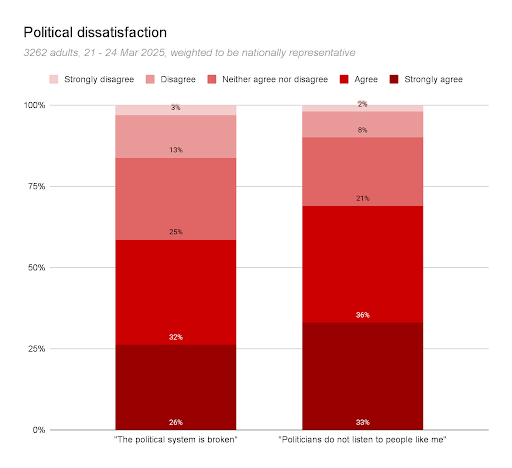
This taps into a broader disillusionment with political institutions and systems’ ability to deliver and a general sense of powerlessness. 58% think that the political system is broken, and 69% think that politicians do not listen to people like them.
This continues to be exploited into a wider anti-politics agenda that allows the far right to present themselves as an alternative to the ‘Westminster elite’. Reform’s recent success at the local elections indicates the growing appetite for more extreme political representation, regardless of whether they are offering genuine political solutions.
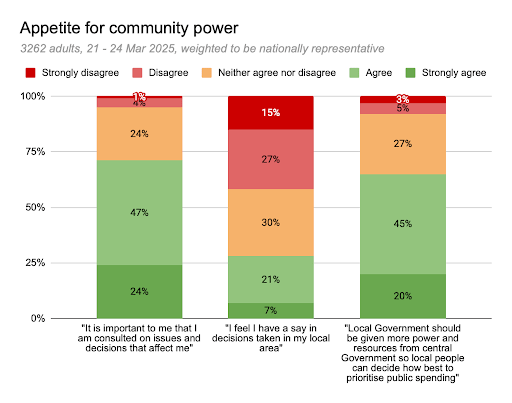
Even if Labour do deliver for the country, deliverism will not be enough to rectify deep rooted mistrust in the political system. The entire relationship between people and power needs to be rebuilt, one where the public feel listened to and serviced, and where politics works for them not just to them. Only 28% of Britons feel like they have a say in what decisions are made in their local area, and 65% want local government to be given more power and resources so that local people can be closer to shaping prioritisation of public spending.
The Devolution and Community Empowerment bill presents the perfect opportunity to pursue genuine power sharing and decentralised decision making. The proposed neighbourhood governance structures could allow local people to have a genuine role in shaping decisions that affect them, making promising strikes towards hyperlocal and sustainable community resilience.
Community resilience: We need solutions at the heart of communities, but in the pockets of Government
An important thread through the vulnerabilities discussed above is the importance of the community unit. Whether it be place-based identity and connection, replacing scarcity narratives with solidarity narratives, or championing collective power, the foundations of this resilience must be built from the bottom up to be truly transformative, sustainable and reflective of the nuances of local need.
It was at the community level that violence flared up last summer, but it was also at the community level that we saw, and continue to see, radical displays of hope and solidarity. Whether it was human chains formed around mosques or local businesses donating supplies for the clean up, people across the country self-organised and self-resourced to reject hate.
Resilient communities are a crucial component in fighting the far right, but communities cannot be left to build this resilience alone. National strategy and guidance that strengthens the social economic and political fabric of communities, and empowers and invests in local ownership and delivery of this work, is essential to support communities to play the pivotal role they can play in resisting the far right.

We need your help to continue our vital research. Your support is not just a donation – it’s a stand against hate and division. It empowers our research and intelligence teams to effectively monitor far-right groups, ensuring we’re prepared for the challenges they bring.