
by JOE MULHALL
Within the far right, debates about who does or does not belong to the nation have always been fundamental. Claims that British or English people are “under attack” rely first on defining who counts as part of the national “in-group” and, just as importantly, who does not.
The dividing line ordinarily falls between the radical and extreme elements of the far right. The radical right accepts the fundamentals of democracy but rejects certain values of liberal democracy, such as minority rights and pluralism, and primarily takes a cultural or civic approach to defining Britishness. Meanwhile, the extreme right, which includes neo-Nazis and fascists, fundamentally rejects democracy, popular sovereignty and majority rule, and defines the nation in racial terms.
This debate is now often described as civic nationalism (civnats) vs ethnonationalism (ethnats). Ethnats believe that the nation is rooted in blood and ancestry. In short, while thorny questions remain over exactly what qualifies as “white” or “British”, being born here is certainly not enough to qualify.
Civic nationalism, however, is arguably a more fluid and ambiguous concept. Most civic nationalists argue to varying degrees that people become part of the nation by living in the country, contributing to it, and investing in its institutions. The term is often used interchangeably with, or as a substitute for, “cultural nationalism,” which is actually narrower and more exclusionary, placing greater emphasis on a shared, inherited culture of language, traditions and history. Both approaches nevertheless agree that people can, in principle, become British regardless of race.
This is not to say civic nationalism cannot also be racist. Scratch the surface and it quickly becomes clear that so-called civnats often smuggle racial thinking into their worldview, with a person of colour’s claims to Englishness or Britishness treated as conditional and revocable.
Over the past two decades, civic and cultural nationalism have been the largest and most successful strands of the British far right. The largest movements would claim to be non-racist and only opposed to radical Islam. While parts of the scene began targeting Muslims specifically during the 1990s, this focus intensified after 9/11, when Islam and Muslims increasingly became their primary or even sole target. Groups such as the English Defence League adopted a narrower, non-biologically racist platform, which became dominant for roughly the next 15 years. Moreover, the successes of the racial- nationalist British National Party in the 2000s were dwarfed by those of UKIP in the 2010s.
Over the past five years, however, this trend has begun to reverse, with a re-racialisation of much of the far-right scene. Although explicitly racial-nationalist organisations remain small and marginal, elements of their ideology have grown more popular across the wider far right and, more alarmingly, have started to seep into the mainstream right.
A key catalyst for this shift was the murder of George Floyd in Minneapolis and the emergence of the Black Lives Matter (BLM) movement in the UK as well as the USA in 2020. Extreme-right groups such as Patriotic Alternative responded predictably with “White Lives Matter” stunts and a coordinated day of action timed to International Indigenous Peoples’ Day. At the same time, figures who had previously avoided overt racial politics began to drop the pretence. This included the anti-Muslim group Britain First and, most notably, Stephen Yaxley-Lennon (AKA Tommy Robinson), who used the BLM protests that summer to promote a far more openly racialised narrative.
THE CURRENT DEBATE
The civnat vs ethnat debate has raged with renewed intensity over the past year, becoming a topic of much discussion on the ever-growing roster of far-right podcasts.
A key figurehead of the ethnat position is Steve Laws, the notorious far-right “influencer” from Kent. Speaking on The Daily Heretic podcast, he laid out his position simply:
“Ethnonationlism is nationalism. […] Realistically, civic nationalists are liberals that do not like Islam. […] A lot of civic nationalists think anyone can be British. They think you come over, you’re born here, you’re British. […] Basically, to simplify it, the civic nationalist approach is about ‘values’ whereas ours is about ethnicity and people and our blood and our people.”
The clearest illustration of this debate, however, came when Laws was a guest on the podcast of Stephen Lennon’s close associate, Liam Tuffs.
The exchange repeatedly returned to the question of whether black Britons can ever truly belong. Tuffs attempted to test Laws’ position by pointing to personal relationships and well-known public figures, citing his black friends and famous members of the black British community such as Frank Bruno and Ian Wright. Laws’ response was typically blunt: “They’ve all got to go. It’s not about how nice they are.”
Tuffs later revisited the same line of questioning in revealing terms, asking: “If Halle Berry was sat opposite you saying, ‘Steve, let me give you a blowjob, no one will find out,’ would you refuse that blowjob?” Laws replied: “Yeah, she’s brown.”
Despite presenting himself as being more moderate, Tuffs’ own comments reveal a hierarchy of belonging that rests on cultural and ethnic distinctions.
Speaking about his black friends, he explains that he sees them as:
“African British, not British British. […] I’m not saying they are British British. In my mind I think they are African British. If they held their culture and their views in front of ours, and they lived here, then I’d say you’re not for the country.”
For Tuffs, this distinction is tied to a rejection of multiculturalism and the assertion of cultural dominance. As he puts it: “Not that I think multiculturalism works, because there has to be a top-tier culture which is the British culture.”
Even when civnats claim to reject biological racism or to allow for conditional inclusion, those conditions are frequently framed in ways that render “non-white” belonging as provisional at best. What emerges is less a disagreement over values than a shared assumption that Britishness is something that must be defended, policed, and ultimately restricted.
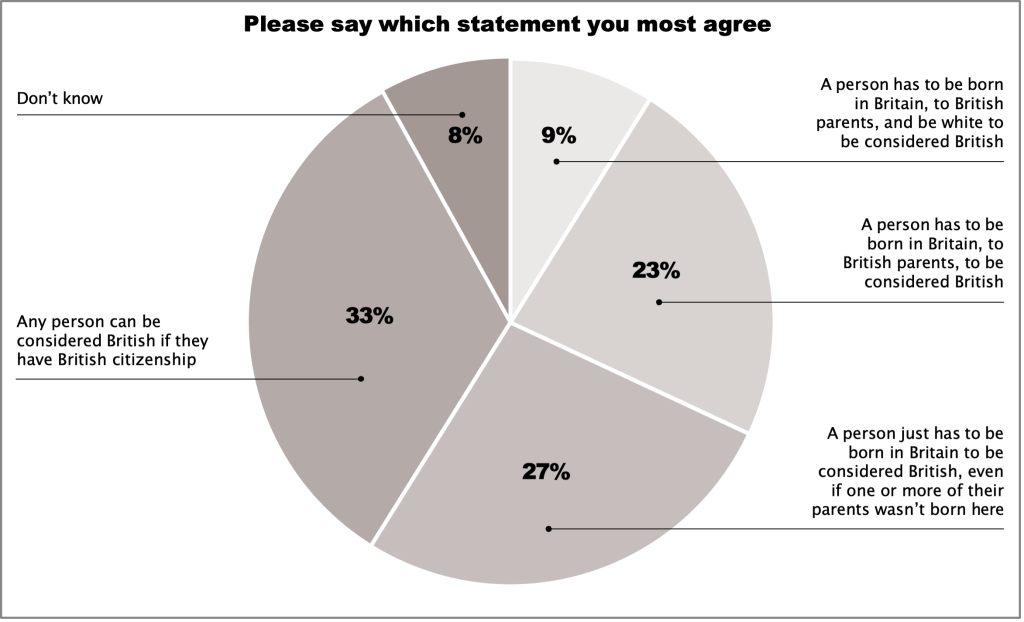
Almost one in ten Britons (9%) think that you have “to be born in Britain, to British parents, and be white to be considered British”, polling from HOPE not hate reveals.
Once again there is a gender divide, with 11% of men believing that being British requires you to be born here, to British parents, and be white, while just 7% of women agree.
A further 23% think a “person has to be born in Britain, to British parents, to be considered British”.
In Wales, 14% believe being British requires you to be born here, to British parents and be white, while a further 28% think you have to be born in the UK to British parents.
Amongst those who voted to leave the EU in the 2016 referendum, 47% agree with both statements, as do 54% of those who say they would vote for Reform UK if a General Election was held today.
While 60% of Britons think that a person can be British simply by having British citizenship or even if their parents were born abroad, the fact that almost a third of people see quite a narrow and racialised view of identity is of deep concern and helps explain why ethnonationalism is gaining ground amongst the far right.
REMIGRATION
The spread of explicitly racial nationalism is dangerous, in part, because of the proposed solutions that follow from such a worldview. Accompanying the rise of ethnonationalism is the belief in the need for so-called “remigration”.
The term, which was popularised by the ethnonationalist Identitarian movement in the 2010s, is a repackaging of older ideas of ethnic cleansing and forced repatriation in softer, more bureaucratic language. Despite its fascist origins, remigration has become an international far-right rallying point after its adoption by the ascendant Alternative für Deutschland (AfD) in 2024, as well as President Donald Trump that year.
In the UK, various groups and individuals have scrambled to take ownership of the term, including the fascist Homeland Party and, most notably, Steve Laws, who last year founded his own pressure group, Remigration Now. The term remains open to interpretation, however. While Laws adopts the most uncompromising position – forcibly removing all those with traces of “non-white” heritage – others, such as Lennon, often use it in reference to asylum seekers or Muslims.
However, while remigration’s proponents often claim it refers only to the voluntary return of migrants, in practice it is rooted in the belief that non-white or non-European populations can never truly belong, regardless of citizenship, length of residence, or cultural integration. By avoiding openly violent language and presenting remigration as a policy solution, the far right seeks to normalise an agenda that would strip millions of people of their rights, while making an extreme and exclusionary worldview appear pragmatic and respectable.
This is tied to the so-called “Great Replacement” theory, an idea created by the French writer Renaud Camus in 2011, which rebrands the old far-right fear of white Europeans being “replaced” by immigrants.
If Englishness or Britishness are defined in racial terms, then immigration and demographic change pose a fundamental threat to the continued existence of the “nation”. As such, a rapid halt to immigration and/or a removal of existing “non-white” communities is required to save the nation.
Increasingly, such ideas have polluted the wider, non- racial, far right, with debates centering around who should be stopped from entering, and which of various communities should be removed, and how.
ENTERING THE MAINSTREAM
Most troubling is the way ethnic conceptions of national identity have moved beyond the traditional far right and have increasingly begun to pollute the mainstream right of British politics. Ideas that were once confined to extremist circles are now being articulated by figures with access to major platforms and audiences, often framed as reasonable concerns about culture, cohesion or demographics.
One of the key figures on the radical right responsible for popularising these ideas is the former academic turned Reform UK candidate Matthew Goodwin.
In a 2024 Substack article warning of Britain’s “demographic CRISIS”, Goodwin argued that “the share of the country’s population that identifies as ‘white British’ is forecast to become a minority group around the year 2070,” adding that “those who oppose these great inflows and do not embrace the rapid ethnic change they cause wonder why it is that politicians seem unable to stop them.” The framing presents demographic change as an obvious problem, without explaining why a rise in people identifying as “black British” or “Asian British” should be cause for alarm. This racialised outlook was further exposed during an appearance on GB News, where Goodwin falsely claimed that “more than 50% of social housing in London is now occupied by people who are not British. This is not acceptable,” despite the true figure being closer to 14%.
The debate reached a much wider audience following an appearance by the former editor of The Spectator, Fraser Nelson, on the popular right-wing podcast Triggernometry. In an exchange with comedian-turned- podcaster Konstantin Kisin, Nelson raised the question of whether former Prime Minister Rishi Sunak should be considered English. Kisin responded bluntly: “I’m not English, I will never be English, I don’t think Rishi Sunak is English. We’re both British but we’re not English.” Nelson pushed back, insisting, “I would say Rishi Sunak is as English as Tizer and Y-fronts. He is absolutely English. He was born and bred here and I wouldn’t say the colour of his skin makes him any less English.” Kisin replied, “He’s a brown Hindu. How is he English?” Nelson responded, “Because he was born and bred here,” before Kisin pressed further: “So by being born here you are English?” Nelson answered, “Yeah. […] It depends if you think English has an ethnic undertone,” to which Kisin concluded, “Of course it does.”
The exchange laid bare the latest battleground in the struggle between civic and ethnic conceptions of nationhood. Increasingly, even in mainstream political and media circles, it has become common to argue that while Britishness is a flexible identity that can be joined through participation, shared values, and citizenship, Englishness is something more restrictive, requiring an ethnic component.
This position was subsequently echoed by former Conservative home secretary Suella Braverman, now a member of Reform UK. Braverman stated: “I’m a proud British Asian. And of course, I’m not English. […] too many people are nervous about asserting English identity for what it is: ethnic, racial and based on ancestry.” Braverman’s statement is a stark illustration of the dangerous creep of ethnonationalism beyond the confines of the extreme right and into the language of senior political figures.
Thankfully, such ideas remain highly marginal among the general public. Polling conducted by More in Common last year found that nearly three quarters (74%) of people in England believe that someone can be English regardless of their skin colour or ethnic background. In addition, only 17% said these factors are important to English identity, while 9% were unsure. While ethnic nationalism may be gaining ground in political debate, it remains far removed from how most people in England understand who belongs.
STOPPING THE ROT
What this debate ultimately exposes is not a meaningful disagreement within the far right about inclusion, but a spectrum of exclusion that runs from the conditional to the absolute. Civic and cultural nationalism may reject the openly biological racism of ethnonationalism, but in practice they often reproduce its core logic: that belonging is something to be tested, monitored, and withdrawn. Whether framed in terms of values, culture, or ancestry, the effect is the same: communities racialised as “other” are treated as provisional guests rather than equal members of the nation.
However, the greater danger lies not in the persistence of fringe ethnonationalist groups, but in the gradual mainstreaming of their concepts. As ethnic definitions of Englishness and Britishness are repeated by media figures and senior politicians, they lend legitimacy to a dangerous worldview.
Thankfully, most people in Britain continue to hold an inclusive understanding of national identity, rooted in shared life rather than shared blood. Challenging the spread of ethnic nationalism, then, is not about inventing new values, but about defending those already held by the majority and recognising that the language used to describe the nation is never neutral, but shapes who is seen as belonging, and who is marked for exclusion.
State of HATE 2026 is your essential guide to the far-right threat—and how we stop it. View the full report today.

We need your help to continue our vital research. Your support is a stand against hate and division. It empowers our research and intelligence teams to effectively monitor far-right groups, ensuring we’re prepared for the challenges they bring.