Last week, Rupert Lowe MP, formerly of Reform UK, announced that his Restore Britain pressure group would change from a “political movement” to a “national political party”. The news instantly created great excitement across the far right, with many of those who deem Reform to be too moderate believing they may have found a home.
At the launch event, Lowe delighted the audience with his policy of mass deportations. “Millions will have to go,” he said. It is this type of extreme rhetoric that has made Lowe the darling of the far right over the last year, and won his new party the support of overt fascists on the very fringes of our politics. Everyone from Katie Hopkins through to Steve Laws and Michael Wright (AKA Morgoth) welcomed the news.
A number of the most influential alternative far-right media outlets have already pledged their support. While these will be considered fringe by most, some have a dedicated following of hundreds of thousands, much of which is young and male, and potentially more radical.
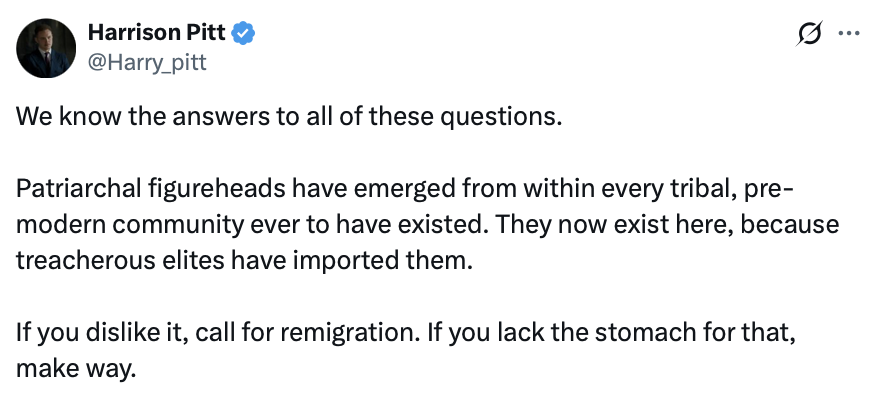
While Lowe himself is already by far the most extreme MP, the team around him is even more radical, with key figures openly advocating for “remigration”. There is a perception in some quarters of the extreme right that his team is essentially ventriloquising him, and they are placing hope in his team rather than Lowe himself.
At present, Restore claims to have 60,000 members, which would make it considerably larger than the British National Party at its height. While it is impossible to predict how Restore will develop over the coming months, there is no doubt that it represents a significant threat that will have a notable effect within the far right and possibly beyond.
At present, Restore represents a realignment within the far right. It is drawing together an uneasy coalition that stretches from figures sitting just to the right of Reform, all the way through to open fascists.
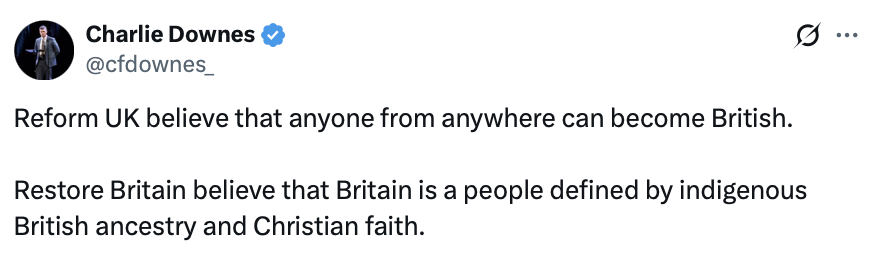
The problem is that this coalition straddles the central fault line on the contemporary far right: the divide between civic nationalists and ethnonationalists. Sooner rather than later, Lowe will have to choose. He can throw the doors open and allow the most extreme elements in. But if he does, many of the civic nationalist types, such as those orbiting Stephen Lennon (AKA Tommy Robinson) and Ben Habib, the leader of Advance UK, will find it difficult to remain in a party alongside neo-Nazis and racial nationalists like Steve Laws. That coalition will fracture.
The alternative is to police the right flank of the party and expel the most openly fascist figures. But that carries its own cost. Large sections of the extreme right will drift away, denouncing Lowe as just another Reform-style operation. He cannot easily hold both wings together as such a coalition is inherently unstable.
If he keeps the extremists inside the tent, Restore could become the largest organised force on the extreme right in decades. However, a party visibly packed with fascists is easy to attack and isolate, and its ceiling would likely be low.
If, instead, he trims the edges and tries to occupy the narrow strip of ground immediately to the right of Reform, he risks ending up with a constituency too small to matter. In either scenario, it is hard to see a path to sustained electoral impact.
That said, we should expect many disgruntled Reform councillors, who might previously have drifted into independence, to now defect to Restore. That could give Restore a faster route to local infrastructure than it would otherwise manage on its own.
Restore’s dilemma would be accentuated by any deal/merger with Ben Habib and his Advance UK outfit. The more extreme Restore supporters will not like someone of Pakistani heritage in a leadership role. In the immediate term they may hold their nose and be tactical, but it would cause problems soon enough. Conversely, Habib/Advance would surely pressure Lowe to kick out the racial nationalists as they would be uncomfortable being in a party with such extreme people. Cracks would very likely soon emerge.
Predicting Restore’s electoral fortunes is complicated by Lowe’s stated ambition to operate as an umbrella. Lowe has already registered a hyperlocal party – Great Yarmouth First – which he intends to be the first of many to appear under a broader Restore brand. That model could make it harder to tie every local candidate directly to the most extreme rhetoric circulating among national supporters.
Then there is the Elon Musk factor. If Musk, who has already voiced support for Lowe on X, were to combine significant financial backing with his capacity to amplify the group’s talking points online, the equation changes. With that kind of support, Restore could become something more serious than a short-lived splinter group.
Even if Restore fails to crystallise into a major electoral threat, it may still shape the terrain. A large extreme-right party with a sitting MP would be unprecedented. More strikingly, Restore currently appears to be viewed in some quarters as more moderate than the reality. That false perception creates space for very hardline rhetoric to seep into more mainstream political discourse.
In that sense, Restore is part of a broader re-racialisation of the British far right. Its politics are more overtly racial than Reform’s, and if it gains traction, it will help normalise language and ideas that were, until recently, confined to the margins. The risk is not simply votes; it is the shifting of the debate itself.
Reform now faces a dilemma of its own. It could attempt to position itself as the respectable, “mainstream” alternative by attacking Restore as extreme and racist. However, if Restore begins to gather momentum, Reform may feel pressure to harden its stance on key issues to avoid being outflanked on its right.
For now, it is worth keeping perspective. Outside online right-wing ecosystems, most people have never heard of Rupert Lowe or Restore. But while it may not be winning elections – especially in the immediate term – it can still poison our politics over time.
Prefer to listen? Click the play button to hear the audio version. Harry Shukman Reform UK is staffed by oddballs and enigmas, but none odder…