“I can’t be bought by anybody,” Reform UK’s leader has said.
Defending himself against his ever-widening financial scandal, Nigel Farage made the case for wealthy businesspeople to enter politics. “The really big question that I want to pose,” he said, “is do we want leaders that know how to make money?”
The question we would like to pose is: what sort of money?
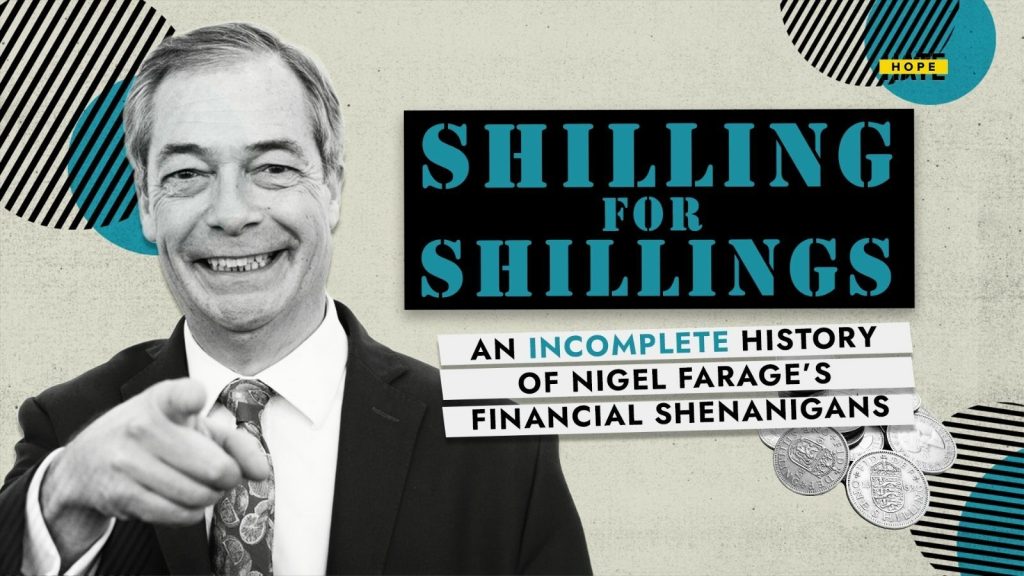
The Reform UK leader is one of Britain’s highest paid MPs thanks to the many lucrative side jobs he has accrued on top of his political roles. Since he became MP for Clacton in 2024, Farage has made around £2 million. “Making money is not a crime,” he said on Tuesday, and while there is no suggestion he has broken the law, scandals of financial impropriety have dogged him throughout his political career.
While he denies any suggestion that additional funding influences his thinking, his critics claim that Farage can in fact be bought.
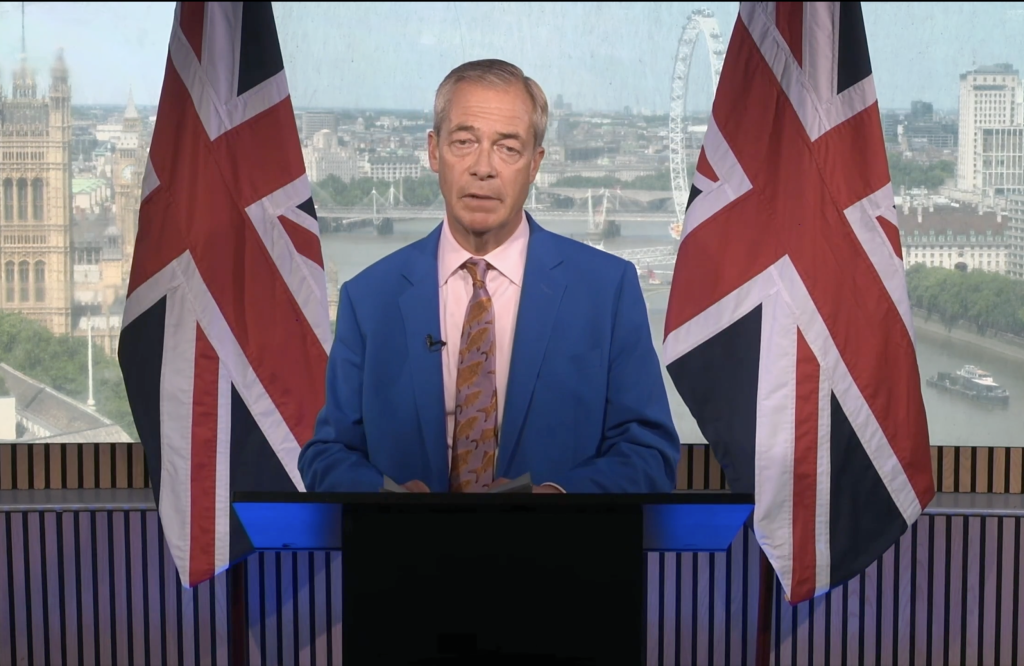
Despite Farage’s claim that he “knows how to make money”, a look at his recent history suggests that he’s actually rather better at taking it.
For the past decade, a considerable part of his income and expenses have come directly from the pockets of a bevy of sugar daddies who seem uncommonly keen to hand their money over to him, no strings attached.
Aaron Banks
One of Farage’s most longstanding and generous backers is Arron Banks, a wealthy business man whose complex financial assets – which include an insurance firm and diamond mines in southern Africa – are largely based in offshore tax havens.
Banks was the biggest single backer of the unofficial Leave.EU campaign of which Farage was the figurehead, donating a total of £8m in the buildup to the Brexit referendum. But Banks’ generosity did not end there; it was later revealed by Channel 4 News that Banks had spent at least £450,000 on bankrolling Farage’s lifestyle in the year that followed the referendum, a sum that included an eye-watering £13,000 monthly rent on a luxurious Chelsea home and chauffeured Land Rover.
Christopher Harborne
By far the wealthiest of Farage’s sugardaddies is Christopher Harborne, the Thailand-based cryptocurrency entrepreneur. Harborne’s status as a political mega-donor was well known; between 2018 and 2026 he donated £1.6m to the Conservative Party and a staggering £25.2m to Reform UK (nee Brexit Party).
These sums make Harborne the biggest political donor in British history but, as with Arron Banks, his official political donations don’t cover the full scale of his generosity. It was not until earlier this year that the Guardian broke the story of a £5m payment that Harborne made directly to Nigel Farage in April 2024.
Both men insist that the payment was a “personal gift”, yet neither has been able to give a clear and believable explanation for why such an extravagant gift was given and, more importantly, why it was not declared to Parliament when Farage took up his seat.
The rules state that newly-elected MPs must declare any gifts or benefits received in the 12 months prior to their election. The reason for such a rule is obvious; it exists to prevent anyone seeking to financially influence an elected official from skirting declaration rules with a “gift” in advance.
And it is hard to imagine a clearer illustration of why such transparency is required than Farage’s actions upon entering Parliament. The main source of Harborne’s wealth is tied to his stake in Tether Ltd, a cryptocurrency company that created one of the most widely used crypto currencies in the world, the dollar-pegged stablecoin USDT.
In September 2025, Farage called a meeting with the Governor of the Bank of England, Andrew Bailey, in order to discuss the Bank’s plans to create its own form of stablecoin tied to the pound, a meeting which Bailey suggested was “lobbying” and that Farage had made his views on the creation of a UK stablecoin “quite clear”.
Farage, of course, claims that the “gift” he’d trousered just months earlier had no strings attached, and so of course his lobbying against the creation of a currency that might threaten the business interests of his benefactor is organic and heartfelt.
Parliamentary rules on declaring interests exist precisely so that the electorate can make an informed decision on whether we believe him.
George Cottrell
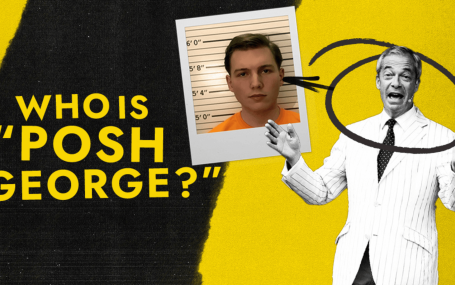
Another long term Farage confidante with exceedingly deep pockets is George Cottrell, the 32-year-old convicted fraudster who has been a close ally for over a decade. While it has been reported that Cottrell refers to Farage with the dubious nickname “Daddy”, recent reporting from the Sunday Times appears to show that it is Cottrell who dispenses the pocket money.
While Cottrell’s criminal history means the party has kept him at arm’s length – always officially denying that he had any formal role with Reform UK – his constant presence at Farage’s side had long been noted. But what had not previously been revealed was that Cottrell was also heavily funding Farage’s lifestyle.
While neither man has been willing to divulge the figures involved, Cottrell is reported to have provided Farage with an elite security force, cars and drivers, a three-strong social media team in the months leading up to the 2024 general election, and even gifted Farage personal use of a multi-million pound townhouse near Buckingham Palace, which sources told the Times Farage is still using.
Yet again, the party is claiming that – despite his ubiquitous presence at Farage’s side – George Cottrell has no involvement in Reform and that the funding of his activity was merely the kind gestures of a friend.
This narrative would take a further hit, however, when the Sunday Times followed up with a piece pointing out that Cottrell had been handing out Reform UK business cards with his own name and Nigel Farage’s email address on them in 2025.

As the leader of Reform, Farage has been accused of allowing donations to influence his political activity (something he denies).
These denials sit uncomfortably with his promotion, for instance, of a pothole-fixing machine called the Pothole Pro, whose maker JCB has donated £200,000 to the party. Farage has repeatedly endorsed the vehicle and even rode in on one at a party event. “I haven’t seen anything more practical or better in solving the pothole problem,” he said last April.
He neglected to add that JC Bamford Excavators had paid for Farage and a staffer to make a helicopter trip to the firm’s Staffordshire premises, valued at more than £8,000.
Among his other donors are the Hong Kong-based crypto billionaire, Ben Delo, who was exposed by HOPE not hate as the funder of The Sanctuary, a base for right-wing projects in Westminster. He has given £4 million to Reform.
The party has also accepted £10,000 from the hedge-fund manager Crispin Odey in the weeks after he was accused of sexual misconduct. Odey has since settled sexual assault claims brought by five women out of court.
As recently as 2022, Reform had a platform of limited support for green energy policies. Since its inception the party has reportedly taken £26 million in donations from sources associated with either fossil fuel interests or climate science denial. Today Reform refers to “net stupid zero” schemes and believes that the increase in atmospheric CO2 is actually beneficial to the environment.
Despite his wealthy backers, the Clacton MP has also dabbled in a range of curious moneymaking schemes.
This includes selling Farage Gin in 2022, offering “a taste of Brexit” at £40 a bottle of luridly-coloured “patriotic” liquid. He also flogged nappies on behalf of US-owned UK We Save (he claims he received no money for promoting the retailer, leaving his involvement in the business mysterious). Both Farage Gin and UK We Save appear to have wound down.
Other schemes have proved much more lucrative, including selling thousands of customised videos via the platform Cameo. The Guardian calculated in March that he had made at least £375,000 since joining Cameo in 2021 (this estimate does not include thousands of additional private videos). The paper’s analysis also showed that he uploaded videos on 212 occasions during parliamentary business in the House of Commons.
In clips sold by Farage, the Clacton MP promoted a neo-Nazi event (“the best thing that ever happened”), repeated an IRA slogan (“up the RA”), and used obscene online slang (“we will promise to hawk-tuah on your bussy as it claps”). He also made misogynistic comments about US congresswoman Alexandria Ocasio-Cortez’s breasts, used far-right slogans, expressed support for the National Front and supported a man jailed for violent disorder in the 2024 riots.
Farage can conceivably claim ignorance for the nature of his Cameo comments, as he is following prompts written by video purchasers. Nonetheless, his willingness to humiliate himself and potentially cause offence by repeating sentences he does not understand is yet another example of how money appears to override principle.
The single biggest payment declared by Farage since becoming an MP is a whopping £270,000 from promoting gold bullion.
Farage declared in his list of MP’s interests that the sum, received from Direct Bullion, was earned over a three month period – for just four hours of work per month. This amounts to roughly £22,500 an hour.
In December 2024, he also received £189,300 from Direct Bullion for four hours of work a month, and subsequent payments of £91,200 in January 2025 and £135,000 that October.
Other revenue streams include charging thousands of pounds an hour as a presenter of GB News and for public speaking gigs.
When Farage was an MEP between 1999 and 2020, he was frequently in the headlines for financial scandals. In 2013, he was exposed for setting up an offshore trust fund on the Isle of Man, which he later said was “a mistake” and cost him money.
His allowances from the European parliament became the subject of controversy. In 2014, he was asked by a journalist how his office, funded by a UKIP supporter, had a £3,000 electricity bill when the average for a building of similar square-footage was a third of that. Farage gave a memorable explanation: “Running machines, running banks of computers, photocopiers, doing things that use a lot more electricity than many household chores and jobs.”
He denied that he had used the MEP remuneration system to make a profit, saying: “I have not sought to make any personal gain from these allowances over the course of the last 15 years”. However, in his autobiography he also acknowledged participating in the “racket” of travel allowances. Farage described this as “[playing] the system”:
“We were awarded £600 for every return journey to Britain, no matter whether we flew club class, by economy airline, by train or in a shared car. We could have hitchhiked. As long as we submitted a boarding-pass or ‘proof of travel’, £600 was paid into our accounts without further question. I bought advance Ryanair tickets from Stansted for a fraction of that sum.”
When questioned by Sky News in 2014, Farage gave an answer that now sounds familiar: “How I spend that money is up to me.”
Last month, the Financial Times reported that Farage paid for Brexit rallies from the EU budget. Around €1.8m of European funds were used to pay for referendum activism in the 2010s. Farage’s spokesman denied any suggestions he broke funding laws.
In 2018, his MEP salary was docked by £35,500 — half his total — after European parliament auditors concluded he misspent EU funds meant for staffing his office. Next year, when Farage turns 63, he will become eligible for an EU pension of around £73,000 a year.
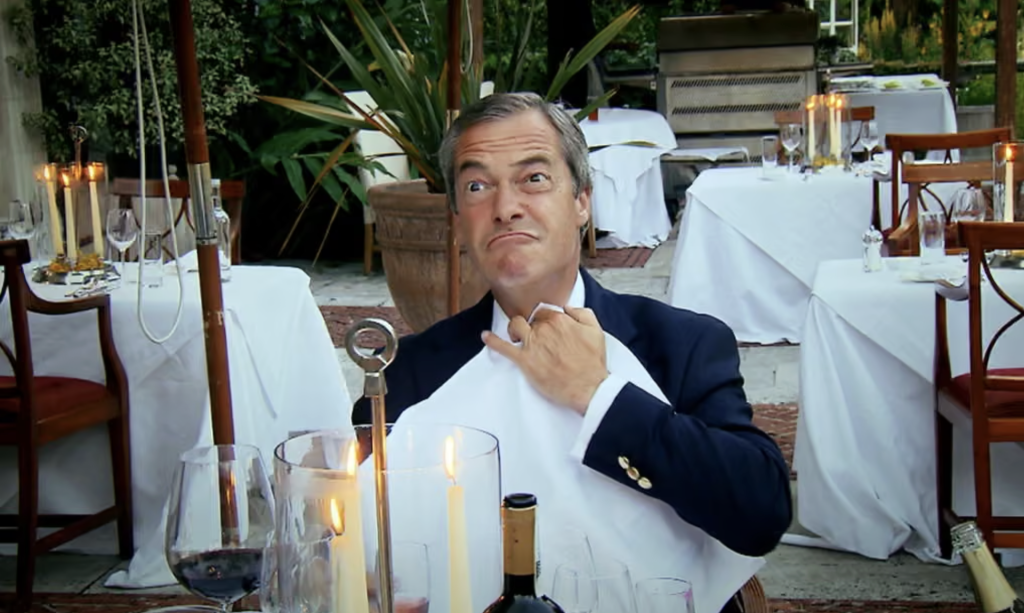
Back in 2014, Nigel Farage appeared on a short-lived spinoff of Gogglebox called Steph & Dom Meet. Sat on the steps of a Grade I-listed manor house in Kent, Farage said he didn’t know anyone in politics as poor as him. “We live in a small semi-detached cottage in the country and I can barely afford to live there,” he said. “We don’t drive flash cars, we don’t have expensive holidays — we haven’t done for ten years. I’m not regretting it, I chose a course of action. Money’s not the be-all and end-all in life.”
Would he say the same today?
Prefer to listen? Click the play button to hear the audio version. Harry Shukman Reform UK is staffed by oddballs and enigmas, but none odder…