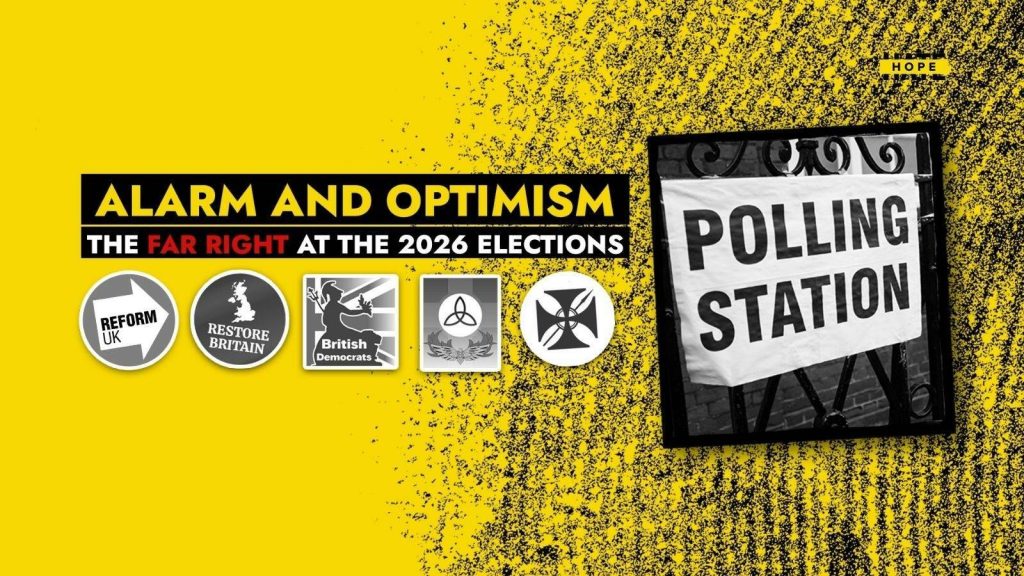
HOPE not hate surveys the fortune of the radical and far right at the local elections
Reflecting on the elections a week on, Reform UK’s performance highlights the party’s significant electoral threat, with these results marking the most number of seats ever won by a British far-right party. But there are also signs that the party can be defeated.
In total, Reform won 1,454 council seats – the most of any party – and majority control of 14 councils. This includes two county councils (Essex and Suffolk), as well as 12 district councils (Thurrock, Havering, Sandwell, Walsall, Newcastle-under-Lyme, St Helens, Calderdale, Wakefield, Barnsley, Sunderland, South Tyneside, and Gateshead).
These numbers obscure the advances Reform made in other parts of England. The party gained a plurality on a further 12 councils: Birmingham, Bradford, Burnley, Cannock Chase, East Sussex, Havant, the Isle of Wight, Kirklees, Norfolk, North East Lincolnshire, Nuneaton & Bedford, and Rochford. Additionally, Reform is the joint largest party in Hartlepool and West Sussex.
Elsewhere, Reform made marked gains in councils where only a third of the seats were up for grabs, meaning they do not yet have overall control. In Wigan, for instance, the party won 24 of the 25 seats up for election and, in Tamworth, Reform won all nine available seats.
The party made significant gains in Wales, where it won 34 out of 96 seats on the Senedd, becoming the second largest party behind Plaid Cymru on 43. Reform had less success in the Holyrood election, but still won 17 out of 129 seats, becoming the joint second largest party with Labour. Reform failed to win a constituency seat in Scotland but gained 17 via the regional list.
Particularly concerning is the election of many of the Reform councillors who had been exposed for holding extreme and racist views. Some have now been expelled or suspended by Reform. However, others – like Andrew Mahon in Blackburn, who said the notorious fascist leader Oswald Mosley “was right 100%” and Caley Ashman in Dudley, who used the antisemitic phrase “goyslop” and enquired about joining the fascist Homeland Party – appear to have remained within Reform.
Reform did not, however, achieve the levels of success it might have hoped. In particular, it failed to achieve its goals in London. In December, Nigel Farage said his party had a “very real chance” of winning in “half a dozen” of the 32 London boroughs; Reform’s key targets included Bromley, Bexley, Barking and Dagenham, and Havering.
Ultimately, the party gained control of just one: the East London borough of Havering, which borders Essex, where Reform did especially well. In Bromley, the Conservatives comfortably held the council and Reform won just six seats.
Overall, the party’s performance was objectively less impressive than at last year’s local elections. In May 2025, Reform won 41% of the available seats and, according to the BBC’s calculations, had a projected national vote share (i.e. the percentage of votes the party would have received if everyone across the country had a chance to vote) of 30%. This time, Reform won 29% of the seats up for election and had a projected national vote share of 26%. While this means Reform would still be the largest party, it suggests the party’s support may have plateaued.
Restore Britain, a Reform splinter headed by Rupert Lowe MP, channeled its considerable resources into just nine seats in Norfolk County Council and another in a Great Yarmouth Borough Council by-election.
The candidates – who stood under the banner of Great Yarmouth First, a Restore sub-party – were supported by hundreds of activists, who flocked to canvas the area from as far as Inverness and Cornwall.
This included a number of well-known fascists and ethnonationalists, such as former BNP councillor Julian Leppert; Callum Barker, an ex-member of the neo-Nazi group Patriotic Alternative and Homeland; and members of Remigration Now, a pro-ethnic cleansing pressure group that campaigns for the deportation of all those with “non-white” heritage from the country, including Britain’s Jewish community.
Restore won its target seats with an average of 47%. Lowe and his supporters have spent the intervening days in breathless celebration. “We’re going to win,” wrote Steve Laws, the ethnic cleansing absolutist who claims to have “daily” contact with Restore’s top team. This line was repeated by Connor Tomlinson, a crankish YouTuber, who went on to describe the results as “proof of concept for Restore Britain’s national ground game”.
Restore hopes to replicate the success in Great Yarmouth by registering hundreds of similar hyperlocal parties, which will operate under the broader Restore umbrella. Lowe appears to sincerely believe that this strategy could deliver a Restore majority at the next general election.
It is worth reiterating that, for all this giddy excitement, Lowe’s party has minimal representation at the local level and is not close to controlling any local authority. Even in Norfolk, Reform boasts four times as many councillors.
The success in Great Yarmouth – the constituency that elected Lowe in 2024 – is no indicator of his national popularity. Moreover, the extensive campaign was possible due to the extremely narrow target, and is unlikely to be replicated when contesting a wider slate of seats.
Elsewhere, Restore fared poorly. In Sheffield, 13 party members appeared on the ballot as “independents”. Restore insisted that these candidates were “not official”, despite the fact they were advertised by the official Restore Sheffield Facebook page and in emails to local party members. Not one candidate came higher than fourth place in their wards, most receiving just 1%.
Nonetheless, the successes in Great Yarmouth, and the ongoing swell of support for Restore across the far right, is a cause for concern. Restore heavily hints at its ethnonationalism without directly stating it, and appears to operate an open door policy to seasoned fascists and other extremists. Some policies echo those pushed by the fascist British National Party, a party that, at its height, was just a fraction of the size of Restore today.
Talk of winning the next general election is undoubtedly delusional. However, if Restore can sustain momentum and avoid splitting along its deep faultlines, it has the potential to shape the terrain by exerting a right-wing pull on Reform. This could provide channels through which the ethnonationalist message can make contact with the mainstream.
As expected, all other far-right parties performed dismally, crushed under the weight of Reform. For now, standing for a right-wing microparty remains little more than an expensive and time-consuming means to inflate one’s sense of self-importance.
The British Democrats, a moribund BNP splinter, has received an influx of younger activists following the collapse of the fascist Homeland Party. This has not translated to an increase in either candidates or votes. The most notable new recruit, Kai Stephens – previously involved in both Patriotic Alternative and Homeland – received a measly 77 votes in Norfolk.
The fringe National Rebirth Party (NRP) stood its first ever candidate, Barry McGrath in Hull; he received 19 votes. Former NRP organiser Perry Barter, in Portsmouth, gained 34.
The National Housing Party UK (NPHUK), a microparty led by former Britain First and BNP organisers, fielded eight candidates, including five in North London. Three quarters of these received fewer than 100 votes.
The “civic nationalist” parties (i.e. those less preoccupied with race) also performed appallingly. UKIP continues to function solely as a conduit for Nick Tenconi’s ego, and the Heritage Party, a crankish UKIP splinter, limps on with no apparent influence. Advance UK – another Reform splinter – appears dead in the water, with even Tommy Robinson, its best-known backer, seemingly losing interest in the party.
In the Scottish Parliamentary elections, the fringe Independent Green Voice (IGV) continues its attempts to siphon confused voters away from the Green Party. Leader Alistair McConnachie, a Holocaust denier, was the sole IGV candidate to receive more than 1% of the vote. Nonetheless, the Scottish Greens claim to have lost a seat due to IGV’s chicanery.
Prefer to listen? Click the play button to hear the audio version. Harry Shukman Reform UK is staffed by oddballs and enigmas, but none odder…