
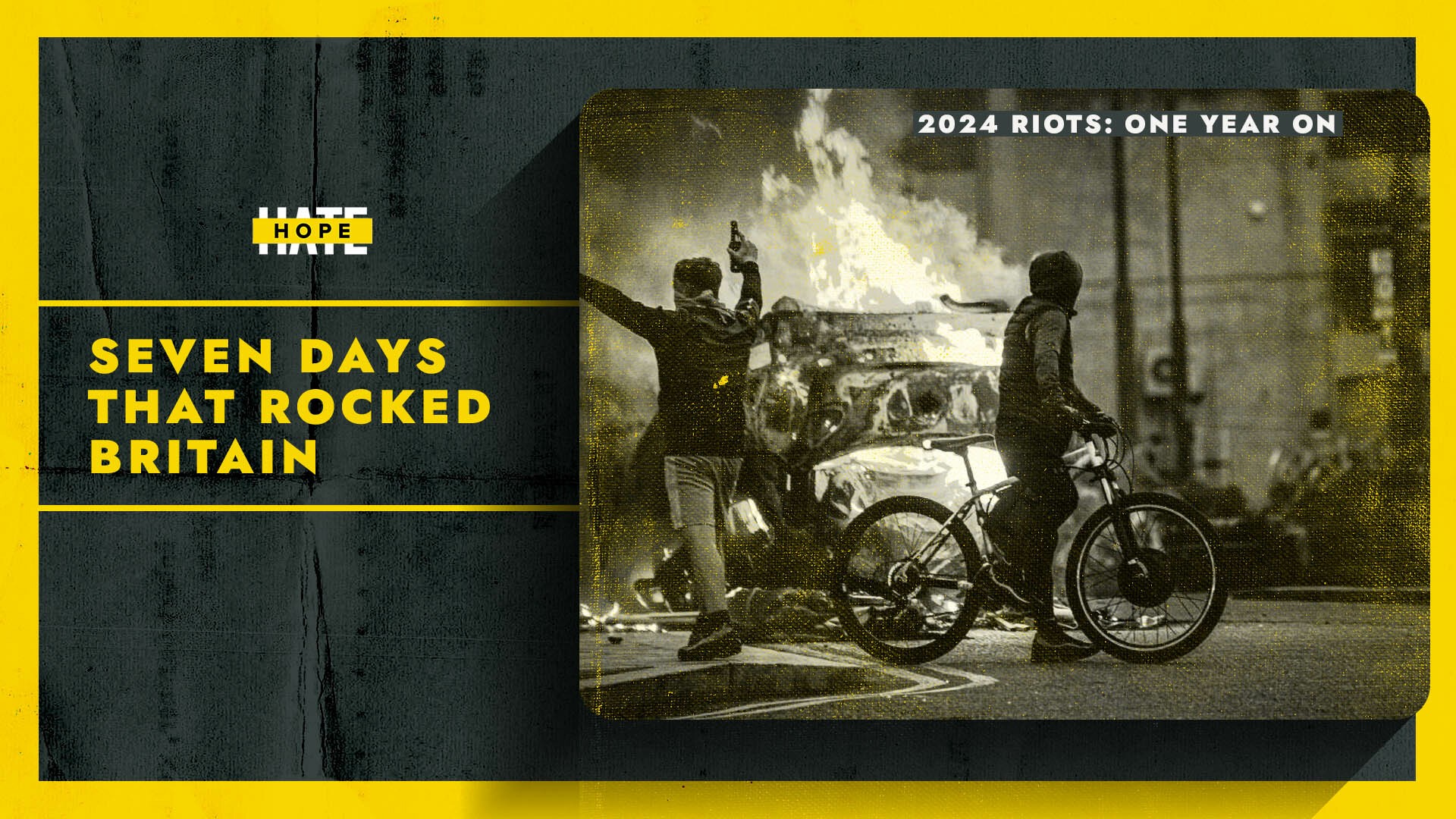
Over the week of 29 July to 5 August 2024, the United Kingdom endured the largest outbreak of far-right rioting and disorder of the post-war period.
Over that seven day period, a spate of extraordinarily violent protests upturned towns and cities across the country, many of which spilled over into full-blown riots.
Far-right actors capitalised on the horrific killing of three children in Southport, Merseyside on 29 July, with a blizzard of disinformation that fed into a wave of protests across the country. These quickly became disconnected from the specifics of Southport and were fuelled by a broad anti-migrant, anti-Muslim, anti-multiculturalism and anti-government agenda.
While some protests passed uneventfully, others saw mobs of masked thugs hurling missiles at police, fighting with counter-protesters, shouting far-right slogans and physically attacking minoritised ethnic communities. Vehicles were set ablaze, homes vandalised and shops opportunistically looted.
Others laid siege to mosques, and asylum accommodation centres in Rotherham and Tamworth were subjected to arson attempts – to the cheers of onlookers – while residents were still inside.
On Monday 5 August, following a weekend of chaos, a list of 39 immigration and asylum services began circulating on extreme Telegram channels, alongside a call for action at 8pm that Wednesday.
HOPE not hate’s analysis at the time stressed that this “hit list” of aspirational targets did not fit with the pattern of organic, decentralised actions of the previous week. It had been local hostilities that drove the targeting of asylum centres in Rotherham and Tamworth, not the direction of a tiny non-local Telegram channel. Our monitoring indicated that very few far-right activists were planning to attend any such events.
Nonetheless, the list soon found an extremely wide circulation across social media and was widely taken as a catalogue of planned mobilisations similar to those of the previous weekend. This resulted in a countrywide panic.
The anti-fascist response was swift and extensive. Huge numbers took to the streets across the country that Wednesday, dwarfing tiny far right turnouts in some locations and complete no shows in others.
This anti-fascist show of force, accompanied by unusually favourable frontpages, changed the popular narrative. This in itself helped to slow the far right’s momentum, deflating some activists who had been jubilant just days earlier. “50 years of anger, turned to ashes in a week. Pretty pathetic” wrote one miserable member of a far-right Telegram group.
Far-Right Riots?
Over a two week period HOPE not hate monitored the events with increasing horror, working to identify those responsible for the violence. We quickly identified figures linked to numerous far-right organisations present at the protests and disturbances, including individuals from the now-defunct English Defence League, Patriotic Alternative, the Infidels network, Britain First, National Rebirth Party, Blood & Honour, British Democrats, some of the UK’s foremost “migrant hunters” and more.
Our analysis also showed that some of the towns and cities worst affected by the anti-Muslim, anti-migrant riots were the same locations that had been repeatedly targeted by far-right activists over the previous three years.
However, despite many of the protests and riots looking extremely similar, with near-indistinguishable targets, slogans, iconography and chants, it became clear that there was no central organiser or organisation behind this national wave of riots. Rather, they were first and foremost a product of the “post-organisational” far right. Most of these disturbances emerged organically and primarily involved local people who are not members of any formal far-right organisations, but were plugged into decentralised far-right networks online.
The Response
The reaction from the government was forceful and swift with thousands of arrests followed by swift convictions and lengthy prison sentences generally for charges relating to violent disorder.
YouGov polling in the immediate aftermath of the riots was damning. The results suggested that “opposition to the riots [was] near-universal across every part of the public”, highlighting the widespread contempt for the thuggery that upturned many towns around the country.
Unsurprisingly, the far right quickly sought to play the victim, claiming to be the target of “two tier” policing. Another narrative to quickly emerge, echoed by elements of the right wing media, tried to reframe the violence as outpourings of “legitimate anger”. These were not people inspired by far-right ideology, this narrative ran, but “concerned patriots” angered by the horrific Southport attack. This has been particularly brazen, given the manner in which mobilisations moved swiftly from anger at the attack to targeting both Muslims and immigration more broadly.
There has also been an attempt to minimise the severity of the crimes for which rioters, and especially the much smaller number of online far-right agitators, have been convicted. This misrepresents the reasons for which people were incarcerated, enabling claims of draconian state overreach.
Far-right groups continue to exploit this sense of grievance. Among the most galling examples is the neo-Nazi group Patriotic Alternative, which has rebranded as a “white civil rights” organisation and raised thousands to “support the families” of convicted rioters.
One Year On
One year on, and the anger and prejudice that led to those riots is still bubbling away under British society. This summer we have already seen anti-migrant rioting in Ballymena and a Loyalist bonfire in the village of Moygashel, Co Tyrone, topped with effigies of refugees in a boat.
Just last week, we saw ugly violence break out at The Bell Hotel in Epping, Essex as an anti-migrant protest spiralled into disorder. A string of smaller protests have followed, accompanied by alarmist headlines in the media.
Worryingly, one year on, the conditions that led to the riots remain. The anger and prejudice, the polarised and struggling communities, the energised and active far right, are all still in place.

We need your help to continue our vital research. Your support is not just a donation – it’s a stand against hate and division. It empowers our research and intelligence teams to effectively monitor far-right groups, ensuring we’re prepared for the challenges they bring.